
Main menu

  • Home
  • Current Issue
  • Archive
  • Info for
    • Authors
    • Editorial Policies
    • Advertisers
    • Editorial Board
    • Special Issues 2025
  • Journal Metrics
  • Other Publications
    • Anticancer Research
    • Cancer Genomics & Proteomics
    • Cancer Diagnosis & Prognosis
  • More
    • IIAR
    • Conferences
  • About Us
    • General Policy
    • Contact
  • Other Publications
    • In Vivo
    • Anticancer Research
    • Cancer Genomics & Proteomics

User menu

  • Register
  • Subscribe
  • My alerts
  • Log in
  • My Cart

Search

  • Advanced search
In Vivo
  • Other Publications
    • In Vivo
    • Anticancer Research
    • Cancer Genomics & Proteomics
  • Register
  • Subscribe
  • My alerts
  • Log in
  • My Cart
In Vivo

Advanced Search

  • Home
  • Current Issue
  • Archive
  • Info for
    • Authors
    • Editorial Policies
    • Advertisers
    • Editorial Board
    • Special Issues 2025
  • Journal Metrics
  • Other Publications
    • Anticancer Research
    • Cancer Genomics & Proteomics
    • Cancer Diagnosis & Prognosis
  • More
    • IIAR
    • Conferences
  • About Us
    • General Policy
    • Contact
  • Visit iiar on Facebook
  • Follow us on Linkedin
Research ArticleExperimental Studies

Osteosarcoma of the Breast in a Patient Derived Orthotopic Xenograft (PDOX) Mouse Model Is Arrested by both Cisplatinum and Eribulin

NORIYUKI MASAKI, NATHANIEL F. WU, YUSUKE AOKI, JUN YAMAMOTO, JUN MIYAZAKI and ROBERT M. HOFFMAN
In Vivo November 2021, 35 (6) 3107-3110; DOI: https://doi.org/10.21873/invivo.12605
NORIYUKI MASAKI
1AntiCancer Inc, San Diego, CA, U.S.A.;
2Graduate School of Medicine, International University of Health and Welfare, Tokyo, Japan;
3Department of Urology, School of Medicine, International University of Health and Welfare, Narita, Japan;
5Department of Surgery, University of California, San Diego, CA, U.S.A.
  • Find this author on Google Scholar
  • Find this author on PubMed
  • Search for this author on this site
NATHANIEL F. WU
1AntiCancer Inc, San Diego, CA, U.S.A.;
4Department of Molecular and Cellular Biology, Harvard University, Cambridge, MA, U.S.A.;
  • Find this author on Google Scholar
  • Find this author on PubMed
  • Search for this author on this site
YUSUKE AOKI
1AntiCancer Inc, San Diego, CA, U.S.A.;
5Department of Surgery, University of California, San Diego, CA, U.S.A.
  • Find this author on Google Scholar
  • Find this author on PubMed
  • Search for this author on this site
JUN YAMAMOTO
1AntiCancer Inc, San Diego, CA, U.S.A.;
5Department of Surgery, University of California, San Diego, CA, U.S.A.
  • Find this author on Google Scholar
  • Find this author on PubMed
  • Search for this author on this site
JUN MIYAZAKI
3Department of Urology, School of Medicine, International University of Health and Welfare, Narita, Japan;
  • Find this author on Google Scholar
  • Find this author on PubMed
  • Search for this author on this site
ROBERT M. HOFFMAN
1AntiCancer Inc, San Diego, CA, U.S.A.;
5Department of Surgery, University of California, San Diego, CA, U.S.A.
  • Find this author on Google Scholar
  • Find this author on PubMed
  • Search for this author on this site
  • For correspondence: all{at}anticancer.com
  • Article
  • Figures & Data
  • Info & Metrics
  • PDF
Loading

Abstract

Background/Aim: Primary osteosarcoma of the mammary gland is a very rare disease, accounting for less than 1% of all mammary malignancies. There is no established first-line treatment and the prognosis is poor compared to normal breast cancer. We previously established the first patient tumor-derived animal model of this disease, grown subcutaneously in nude mice. In the present study, we established a patient derived orthotopic xenograft (PDOX) model of osteosarcoma of the breast and investigated the efficacy of cisplatinum (CDDP) and eribulin (ERB). Materials and Methods: PDOX models of primary osteosarcoma of the breast were divided into 3 groups (5-6 mice per group): untreated control; CDDP treatment; ERB treatment. The tumor volume in the 3 groups was compared after 2 weeks. Results: There were significant differences between control and CDDP, and control and ERB (p=0.036, 0.046, respectively). However, there was no significant difference between CDDP and ERB (p=0.964). Conclusion: CDDP and ERB are candidates for first-line clinical therapy of primary osteosarcoma of the breast.

  • Breast osteosarcoma
  • efficacy
  • cisplatinum
  • eribulin
  • first-line
  • PDOX
  • patient-derived orthotopic xenograft
  • nude mouse

Primary osteosarcoma of the mammary gland is a rare disease that accounts for 0.2-1% of all breast malignancies (1-3). Because the number of cases is extremely small, no first-line treatment has been determined. The 5-year survival rate for this disease has been reported to be 38% (1), and the prognosis is worse than breast carcinoma which has a 5-year survival rate of 90.2% (4). Therefore, there is a need to establish the first-line treatment for primary osteosarcoma of the mammary gland.

Cisplatinum (CDDP) is a platinum complex, which was introduced into clinical practice for cancer in the 1970s and is indicated for the treatment of a wide variety of cancers (5). CDDP is still first-line treatment for osteosarcoma of the bone (6). Eribulin (ERB), a halichondrin-based inhibitor of microtubule dynamics, with a novel mechanism of action, targets the microtubule plus-end and destabilizes microtubules by inhibiting microtubule elongation (7, 8). In clinical practice, ERB treatment of soft tissue sarcoma has been initiated and has shown some efficacy (9).

In our previous study, we showed that ERB is effective in PDOX mouse models of primary bone osteosarcoma (10). We recently established a nude mouse model of mammary primary osteosarcoma growing subcutaneously (11). In the present study we established a patient-derived orthotopic xenograft (PDOX) mouse model of primary osteosarcoma of the breast to determine the efficiency of CDDP and ERB.

Materials and Methods

Mice. Athymic (nu/nu) nude mice (AntiCancer, Inc., San Diego, CA, USA), 4-6 weeks old, were used in the present study. All mouse experiments were performed with an AntiCancer Inc. Institutional Animal Care and Use Committee (IACUC)-protocol specifically authorized for the present study. The National Institutes of Health (NIH) guidelines for the Care and Use of Animals under Assurance Number A3873-1 were followed for the use of the mice. The detailed procedures and methods of anesthesia, surgery, and mouse breeding follow previously described methods for the establishment of PDOX (11).

Patient-derived tumor. The primary osteosarcoma of the breast was previously obtained from the Kaiser Permanente San Diego Medical Center with an approved protocol (IRB#12617) (11).

Establishment of the PDOX breast osteosarcoma model. A 5-mm incision was made on the skin above the left mammary tissue to create a pocket for the tumor. A 3-4 mm tumor fragment was inserted into the pocket, and the skin was sutured with a single ligation of a 4-0 nylon suture, as previously described (11).

Treatment scheme. Three weeks after orthotopic implantation, the tumor volume reached 50 mm3, and treatment was started. PDOX mouse models of primary osteosarcoma were randomly assigned to the following three groups: control group; CDDP group (6 mg/kg, once a week, intraperitoneal injection); ERB group (1.5 mg/kg, once a week, intraperitoneal injection) (Figure 1). The short and long axis of the tumor was measured using a calipers and the mice were weighed once a week. The volume of the tumor was determined as follows: short axis × short axis × long axis / 2. All mice were sacrificed on the 15th day after treatment. The tumors were then collected for histological evaluation.

Figure 1.
  • Download figure
  • Open in new tab
  • Download powerpoint
Figure 1.

Treatment scheme of the breast-osteosarcoma PDOX nude-mouse models. CDDP: cisplatinum; ERB: eribulin.

Hematoxylin and eosin (H&E) staining. The H&E staining procedure was performed according to standard protocols.

Statistical analysis. All statistical analyses were performed using EZR (Saitama Medical Center, Jichi Medical University, Saitama, Japan), a graphical user interface for R (The R Foundation for Statistical Computing, Vienna, Austria) (12). The relative tumor volumes and relative mice body weight are presented as mean±SD. Tukey-Kramer analysis was used for comparisons among the three groups. Differences with a probability value of p≤0.05 were considered statistically significant.

Results

Treatment efficacy on the breast osteosarcoma-PDOX. There was a significant difference between the control group and the CDDP group, and between the control group and the ERB group (p=0.036, p=0.046, respectively), but there was no significant difference between the CDDP group and the ERB group (p=0.964) (Figure 2). There was no significant difference in any group in the body weight of mice on the 1st day and 15th day (Figure 3).
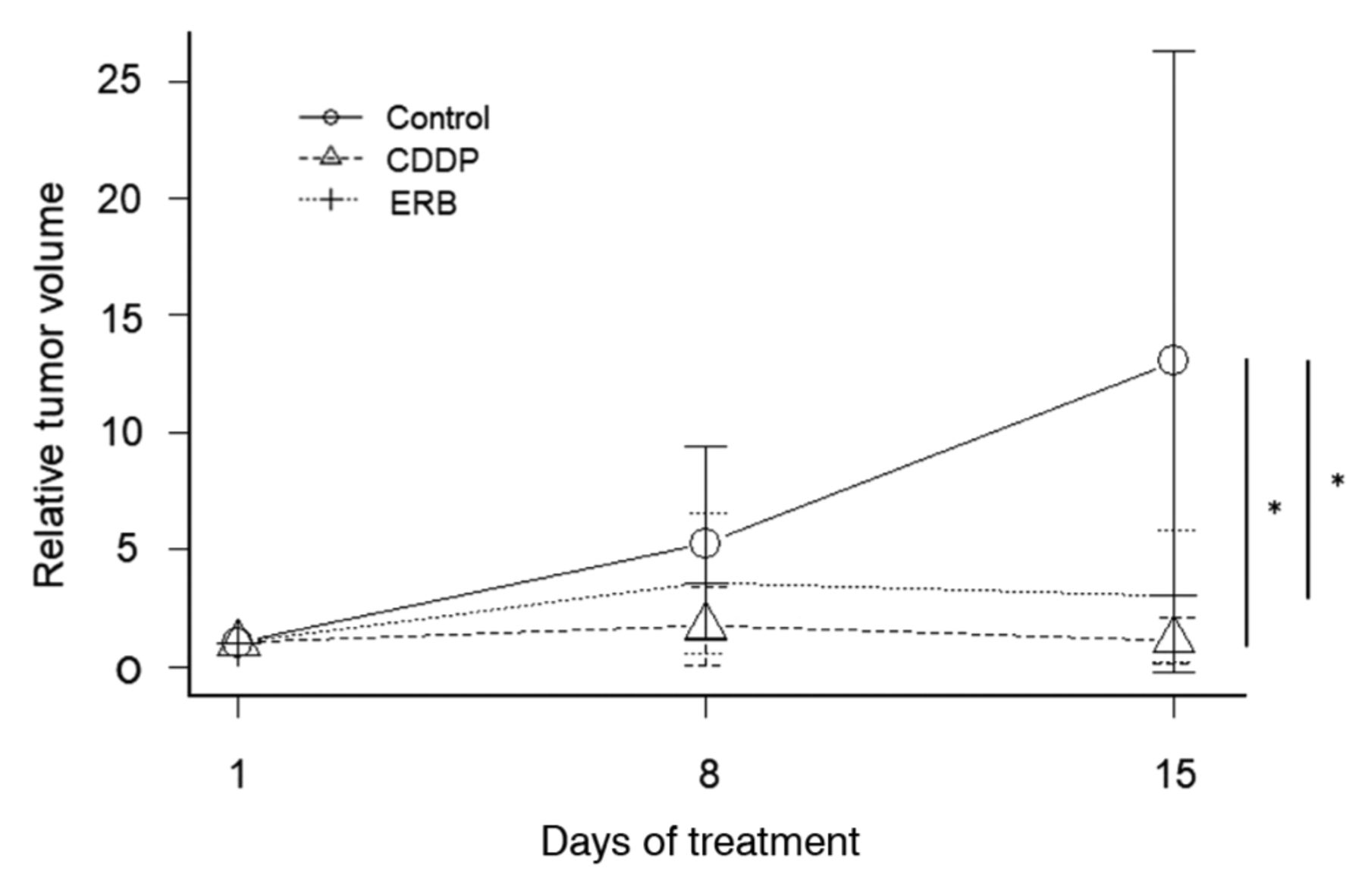
Figure 2.
  • Download figure
  • Open in new tab
  • Download powerpoint
Figure 2.

Efficacy of drugs on the breast osteosarcoma-PDOX. Line graphs show tumor volume at the indicated times relative to that at the start of treatment. *p≤0.05. Error bars: ±SD. CDDP: cisplatinum; ERB: eribulin.

Figure 3.
  • Download figure
  • Open in new tab
  • Download powerpoint
Figure 3.

Mouse body weight. Bar graphs show body weight of mice from each group at day 15 relative to day 1 of treatment.

Histology of breast osteosarcoma-PDOX in H&E-stained sections obtained from paraffin-embedded formalin-fixed fixed tissues. In the untreated-control group, pleomorphic spindle cells were observed, and some of them showed increased nuclear mitosis. In addition, malignant osteoid formation was observed in the stroma in the control mice (Figure 4A). In contrast, the CDDP- and ERB-treatment groups showed an obvious decrease in the density of pleomorphic spindle cells (Figure 4B and C).
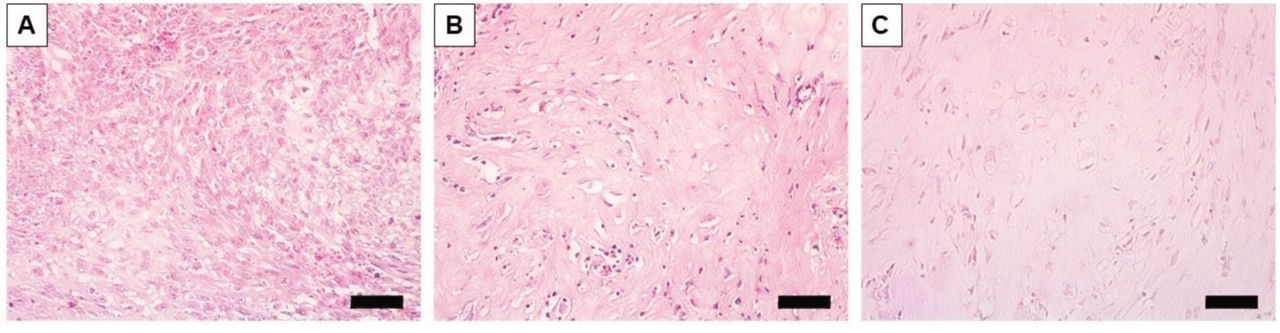
Figure 4.
  • Download figure
  • Open in new tab
  • Download powerpoint
Figure 4.

Representative photomicrographs of H & E-stained breast-osteosarcoma PDOX tissue sections. (A) Untreated control. (B) Cisplatinum-treated. (C) Eribulin-treated. Scale bar: 50 μm.

Discussion

Extraskeletal osteosarcoma accounts for about 4% of all osteosarcomas (13). While osteosarcoma of bone origin occurs mainly in the first two decades of life, extraskeletal osteosarcoma mainly affects the elderly, aged 65 and older (14). The mechanism by which osteosarcoma develops exosteographically is not well understood. Primary osteosarcoma of the mammary gland has been suggested to originate from mesenchymal cells within the mammary gland, or to be the result of excessive development of mesenchymal cancer cells such as fibroadenoma or phyllodes tumor (1, 15). Chemotherapy for osteosarcoma of the breast has been tried mainly with first-line treatment for osteosarcoma of bone origin, including methotrexate, doxorubicin (DOX), CDDP, and ifosfamide, either alone or in combination (16). However no first-line therapy has been established for breast osteosarcoma. In the PDOX model, tumors are growing in the mammary gland of mice, making it a clinically-relevant model and a candidate for clinical treatment can possibly be identified. Our recent studies have also shown that ERB is effective for tumor regression in a bone-derived osteosarcoma PDOX model (10) and in CDDP- and DOX-resistant lung metastatic osteosarcoma (17). ERB has been reported in recent studies to be combined with a wide range of anticancer agents (18). ERB’s anti-tumor mechanism of action is based on the modulation of the tumor microenvironment and vascular remodeling (19).

Although in the present study ERB did not show greater efficacy than CDDP, the present study suggests that both ERB and CDDP have promise as first-line treatment for osteosarcoma of mammary origin.

Acknowledgements

This paper is dedicated to the memory of A. R. Moossa, M.D., Sun Lee, M.D., Professor Li Jiaxi and Masaki Kitajima, M.D.

Footnotes

  • This article is freely accessible online.

  • Author’s Contributions

    N.M. and N.F.W. conceived the study, N.M. and Y.A. performed the experiments and J.Y., J.M. and R.M.H. provided scientific advice. N.M. wrote the paper and R.M.H. revised the paper. R.M.H. supervised the study.

  • Conflicts of Interest

    The Authors declare that they have no conflicts of interest in relation to this study. AntiCancer Inc. uses PDOX models for contract research.

  • Funding

    The Robert M. Hoffman Foundation for Cancer Research provided funds for the study.

  • Received August 24, 2021.
  • Revision received September 10, 2021.
  • Accepted September 13, 2021.
  • Copyright © 2021 The Author(s). Published by the International Institute of Anticancer Research.

References

  1. ↵
    1. Silver SA and
    2. Tavassoli FA
    : Primary osteogenic sarcoma of the breast: a clinicopathologic analysis of 50 cases. Am J Surg Pathol 22(8): 925-933, 1998. PMID: 9706972. DOI: 10.1097/00000478-199808000-00002
    OpenUrlCrossRefPubMed
    1. Pollard SG,
    2. Marks PV,
    3. Temple LN and
    4. Thompson HH
    : Breast sarcoma. A clinicopathologic review of 25 cases. Cancer 66(5): 941-944, 1990. PMID: 2386920. DOI: 10.1002/1097-0142(19900901)66:5<941::aid-cncr2820660522>3.0.co;2-b
    OpenUrlCrossRefPubMed
  2. ↵
    1. Kennedy T and
    2. Biggart JD
    : Sarcoma of the breast. Br J Cancer 21(4): 635-644, 1967. PMID: 4294611. DOI: 10.1038/bjc.1967.74
    OpenUrlCrossRefPubMed
  3. ↵
    1. Allemani C,
    2. Matsuda T,
    3. Di Carlo V,
    4. Harewood R,
    5. Matz M,
    6. Nikšić M,
    7. Bonaventure A,
    8. Valkov M,
    9. Johnson CJ,
    10. Estève J,
    11. Ogunbiyi OJ,
    12. Azevedo E Silva G,
    13. Chen WQ,
    14. Eser S,
    15. Engholm G,
    16. Stiller CA,
    17. Monnereau A,
    18. Woods RR,
    19. Visser O,
    20. Lim GH,
    21. Aitken J,
    22. Weir HK,
    23. Coleman MP and CONCORD Working Group
    : Global surveillance of trends in cancer survival 2000-14 (CONCORD-3): analysis of individual records for 37 513 025 patients diagnosed with one of 18 cancers from 322 population-based registries in 71 countries. Lancet 391(10125): 1023-1075, 2018. PMID: 29395269. DOI: 10.1016/S0140-6736(17)33326-3
    OpenUrlCrossRefPubMed
  4. ↵
    1. Kelland L
    : The resurgence of platinum-based cancer chemotherapy. Nat Rev Cancer 7(8): 573-584, 2007. PMID: 17625587. DOI: 10.1038/nrc2167
    OpenUrlCrossRefPubMed
  5. ↵
    1. Smrke A,
    2. Anderson PM,
    3. Gulia A,
    4. Gennatas S,
    5. Huang PH and
    6. Jones RL
    : Future directions in the treatment of osteosarcoma. Cells 10(1): 172, 2021. PMID: 33467756. DOI: 10.3390/cells10010172
    OpenUrlCrossRefPubMed
  6. ↵
    1. Dumontet C and
    2. Jordan MA
    : Microtubule-binding agents: a dynamic field of cancer therapeutics. Nat Rev Drug Discov 9(10): 790-803, 2010. PMID: 20885410. DOI: 10.1038/nrd3253
    OpenUrlCrossRefPubMed
  7. ↵
    1. Smith JA,
    2. Wilson L,
    3. Azarenko O,
    4. Zhu X,
    5. Lewis BM,
    6. Littlefield BA and
    7. Jordan MA
    : Eribulin binds at microtubule ends to a single site on tubulin to suppress dynamic instability. Biochemistry 49(6): 1331-1337, 2010. PMID: 20030375. DOI: 10.1021/bi901810u
    OpenUrlCrossRefPubMed
  8. ↵
    1. Miwa S,
    2. Yamamoto N,
    3. Hayashi K,
    4. Takeuchi A,
    5. Igarashi K and
    6. Tsuchiya H
    : Therapeutic targets for bone and soft-tissue sarcomas. Int J Mol Sci 20(1): 170, 2019. PMID: 30621224. DOI: 10.3390/ijms20010170
    OpenUrlCrossRefPubMed
  9. ↵
    1. Wu NF,
    2. Yamamoto J,
    3. Aoki Y,
    4. Bouvet M and
    5. Hoffman RM
    : Eribulin inhibits osteosarcoma in a clinically-accurate bone-tumor-insertion PDOX mouse model. Anticancer Res 41(4): 1779-1784, 2021. PMID: 33813382. DOI: 10.21873/anticanres.14943
    OpenUrlAbstract/FREE Full Text
  10. ↵
    1. Wu NF,
    2. Wu J,
    3. Yamamoto J,
    4. Aoki Y,
    5. Hozumi C,
    6. Bouvet M and
    7. Hoffman RM
    : The first mouse model of primary osteosarcoma of the breast. In Vivo 35(4): 1979-1983, 2021. PMID: 34182472. DOI: 10.21873/invivo.12466
    OpenUrlAbstract/FREE Full Text
  11. ↵
    1. Kanda Y
    : Investigation of the freely available easy-to-use software ‘EZR’ for medical statistics. Bone Marrow Transplant 48(3): 452-458, 2013. PMID: 23208313. DOI: 10.1038/bmt.2012.244
    OpenUrlCrossRefPubMed
  12. ↵
    1. Allan CJ and
    2. Soule EH
    : Osteogenic sarcoma of the somatic soft tissues. Clinicopathologic study of 26 cases and review of literature. Cancer 27(5): 1121-1133, 1971. PMID: 5281245. DOI: 10.1002/1097-0142(197105)27:5<1121::aid-cncr2820270519>3.0.co;2-3
    OpenUrlCrossRefPubMed
  13. ↵
    1. Vorobiof G,
    2. Hariparsad G,
    3. Freinkel W,
    4. Said H and
    5. Vorobiof DA
    : Primary osteosarcoma of the breast: a case report. Breast J 9(3): 231-233, 2003. PMID: 12752633. DOI: 10.1046/j.1524-4741.2003.09320.x
    OpenUrlCrossRefPubMed
  14. ↵
    1. Remadi S,
    2. Doussis-Anagnostopoulu I and
    3. Mac Gee W
    : Primary osteosarcoma of the breast. Pathol Res Pract 191(5): 471-4; discussion 475-7, 1995. PMID: 7479366. DOI: 10.1016/S0344-0338(11)80737-5
    OpenUrlCrossRefPubMed
  15. ↵
    1. Momoi H,
    2. Wada Y,
    3. Sarumaru S,
    4. Tamaki N,
    5. Gomi T,
    6. Kanaya S,
    7. Katayama T,
    8. Ootoshi M and
    9. Fukumoto M
    : Primary osteosarcoma of the breast. Breast Cancer 11(4): 396-400, 2004. PMID: 15604996. DOI: 10.1007/BF02968048
    OpenUrlCrossRefPubMed
  16. ↵
    1. Kiyuna T,
    2. Tome Y,
    3. Miyake K,
    4. Murakami T,
    5. Oshiro H,
    6. Igarashi K,
    7. Kawaguchi K,
    8. Hsu J,
    9. Singh M,
    10. Li Y,
    11. Nelson S,
    12. Bouvet M,
    13. Singh SR,
    14. Kanaya F and
    15. Hoffman RM
    : Eribulin suppressed cisplatinum- and doxorubicin-resistant recurrent lung metastatic osteosarcoma in a patient-derived orthotopic xenograft mouse model. Anticancer Res 39(9): 4775-4779, 2019. PMID: 31519578. DOI: 10.21873/anticanres.13661
    OpenUrlAbstract/FREE Full Text
  17. ↵
    1. Asano M,
    2. Matsui J,
    3. Towle MJ,
    4. Wu J,
    5. McGonigle S,
    6. DE Boisferon MH,
    7. Uenaka T,
    8. Nomoto K and
    9. Littlefield BA
    : Broad-spectrum preclinical antitumor activity of eribulin (Halaven®): combination with anticancer agents of differing mechanisms. Anticancer Res 38(6): 3375-3385, 2018. PMID: 29848686. DOI: 10.21873/anticanres.12604
    OpenUrlAbstract/FREE Full Text
  18. ↵
    1. Ito K,
    2. Hamamichi S,
    3. Abe T,
    4. Akagi T,
    5. Shirota H,
    6. Kawano S,
    7. Asano M,
    8. Asano O,
    9. Yokoi A,
    10. Matsui J,
    11. Umeda IO and
    12. Fujii H
    : Antitumor effects of eribulin depend on modulation of the tumor microenvironment by vascular remodeling in mouse models. Cancer Sci 108(11): 2273-2280, 2017. PMID: 28869796. DOI: 10.1111/cas.13392
    OpenUrlCrossRefPubMed
PreviousNext
Back to top

In this issue

In Vivo
Vol. 35, Issue 6
November-December 2021
  • Table of Contents
  • Table of Contents (PDF)
  • Index by author
  • Back Matter (PDF)
  • Ed Board (PDF)
  • Front Matter (PDF)
Print
Download PDF
Article Alerts
Sign In to Email Alerts with your Email Address
Email Article

Thank you for your interest in spreading the word on In Vivo.

NOTE: We only request your email address so that the person you are recommending the page to knows that you wanted them to see it, and that it is not junk mail. We do not capture any email address.

Enter multiple addresses on separate lines or separate them with commas.
Osteosarcoma of the Breast in a Patient Derived Orthotopic Xenograft (PDOX) Mouse Model Is Arrested by both Cisplatinum and Eribulin
(Your Name) has sent you a message from In Vivo
(Your Name) thought you would like to see the In Vivo web site.
CAPTCHA
This question is for testing whether or not you are a human visitor and to prevent automated spam submissions.
17 + 1 =
Solve this simple math problem and enter the result. E.g. for 1+3, enter 4.
Citation Tools
Osteosarcoma of the Breast in a Patient Derived Orthotopic Xenograft (PDOX) Mouse Model Is Arrested by both Cisplatinum and Eribulin
NORIYUKI MASAKI, NATHANIEL F. WU, YUSUKE AOKI, JUN YAMAMOTO, JUN MIYAZAKI, ROBERT M. HOFFMAN
In Vivo Nov 2021, 35 (6) 3107-3110; DOI: 10.21873/invivo.12605

Citation Manager Formats

  • BibTeX
  • Bookends
  • EasyBib
  • EndNote (tagged)
  • EndNote 8 (xml)
  • Medlars
  • Mendeley
  • Papers
  • RefWorks Tagged
  • Ref Manager
  • RIS
  • Zotero
Reprints and Permissions
Share
Osteosarcoma of the Breast in a Patient Derived Orthotopic Xenograft (PDOX) Mouse Model Is Arrested by both Cisplatinum and Eribulin
NORIYUKI MASAKI, NATHANIEL F. WU, YUSUKE AOKI, JUN YAMAMOTO, JUN MIYAZAKI, ROBERT M. HOFFMAN
In Vivo Nov 2021, 35 (6) 3107-3110; DOI: 10.21873/invivo.12605
Twitter logo Facebook logo Mendeley logo
  • Tweet Widget
  • Facebook Like
  • Google Plus One

Jump to section

  • Article
    • Abstract
    • Materials and Methods
    • Results
    • Discussion
    • Acknowledgements
    • Footnotes
    • References
  • Figures & Data
  • Info & Metrics
  • PDF

Related Articles

  • No related articles found.
  • PubMed
  • Google Scholar

Cited By...

  • Establishing a Mandibular Osteosarcoma Model in SD Rats Using Tissue Block Transplantation
  • Oral-recombinant Methioninase in Combination With Rapamycin Eradicates Osteosarcoma of the Breast in a Patient-derived Orthotopic Xenograft Mouse Model
  • Oral-recombinant Methioninase Lowers the Effective Dose and Eliminates Toxicity of Cisplatinum for Primary Osteosarcoma of the Mammary Gland in a Patient-derived Orthotopic Xenograft Mouse Model
  • Effect of Eribulin on Angiogenesis and the Expression of Endothelial Adhesion Molecules
  • Oral-recombinant Methioninase Converts an Osteosarcoma from Methotrexate-resistant to -sensitive in a Patient-derived Orthotopic-xenograft (PDOX) Mouse Model
  • Google Scholar

More in this TOC Section

  • Effect of Decay-accelerating Factor on LPS-induced Acute Lung Injury in the Rat
  • Early and Late Effects of Difluorodeoxycytidine on Murine Cell Radiosensitivity In Vivo
  • Reduced Pain Responses With a Digital Automatic Syringe: Behavioral and Molecular Evidence in a Rodent Formalin Model
Show more Experimental Studies

Similar Articles

Keywords

  • Breast osteosarcoma
  • efficacy
  • cisplatinum
  • Eribulin
  • first-line
  • PDOX
  • patient-derived orthotopic xenograft
  • nude mouse
In Vivo

© 2025 In Vivo

Powered by HighWire