
Main menu

  • Home
  • Current Issue
  • Archive
  • Info for
    • Authors
    • Editorial Policies
    • Advertisers
    • Editorial Board
    • Special Issues
  • Journal Metrics
  • Other Publications
    • Anticancer Research
    • Cancer Genomics & Proteomics
    • Cancer Diagnosis & Prognosis
  • More
    • IIAR
    • Conferences
  • About Us
    • General Policy
    • Contact
  • Other Publications
    • In Vivo
    • Anticancer Research
    • Cancer Genomics & Proteomics

User menu

  • Register
  • Subscribe
  • My alerts
  • Log in
  • My Cart

Search

  • Advanced search
In Vivo
  • Other Publications
    • In Vivo
    • Anticancer Research
    • Cancer Genomics & Proteomics
  • Register
  • Subscribe
  • My alerts
  • Log in
  • My Cart
In Vivo

Advanced Search

  • Home
  • Current Issue
  • Archive
  • Info for
    • Authors
    • Editorial Policies
    • Advertisers
    • Editorial Board
    • Special Issues
  • Journal Metrics
  • Other Publications
    • Anticancer Research
    • Cancer Genomics & Proteomics
    • Cancer Diagnosis & Prognosis
  • More
    • IIAR
    • Conferences
  • About Us
    • General Policy
    • Contact
  • Visit iiar on Facebook
  • Follow us on Linkedin
Research ArticleClinical Studies

Accurate Monitoring of Parkinson’s Disease Symptoms With a Wearable Device During COVID-19 Pandemic

KONSTANTINOS I. TSAMIS, GEORGE RIGAS, KOSTIKIS NIKOLAOS, DIMITRIOS I. FOTIADIS and SPYRIDON KONITSIOTIS
In Vivo July 2021, 35 (4) 2327-2330; DOI: https://doi.org/10.21873/invivo.12507
KONSTANTINOS I. TSAMIS
1Department of Neurology, University Hospital of Ioannina, Ioannina, Greece;
  • Find this author on Google Scholar
  • Find this author on PubMed
  • Search for this author on this site
  • For correspondence: ktsamis{at}uoi.gr
GEORGE RIGAS
2Unit of Medical Technology and Intelligent Information System, Department of Materials Science and Engineering, University of Ioannina, Ioannina, Greece;
3PD Neurotechnology Ltd, Ioannina, Greece
  • Find this author on Google Scholar
  • Find this author on PubMed
  • Search for this author on this site
KOSTIKIS NIKOLAOS
3PD Neurotechnology Ltd, Ioannina, Greece
  • Find this author on Google Scholar
  • Find this author on PubMed
  • Search for this author on this site
DIMITRIOS I. FOTIADIS
2Unit of Medical Technology and Intelligent Information System, Department of Materials Science and Engineering, University of Ioannina, Ioannina, Greece;
  • Find this author on Google Scholar
  • Find this author on PubMed
  • Search for this author on this site
SPYRIDON KONITSIOTIS
1Department of Neurology, University Hospital of Ioannina, Ioannina, Greece;
  • Find this author on Google Scholar
  • Find this author on PubMed
  • Search for this author on this site
  • Article
  • Figures & Data
  • Info & Metrics
  • PDF
Loading

Abstract

Background: Accurate assessment of symptoms in Parkinson’s disease (PD) is essential for optimal treatment decisions. During the past few years, different monitoring modalities have started to be used in the everyday clinical practice, mainly for the evaluation of motor symptoms. However, monitoring technologies for PD have not yet gained wide acceptance among physicians, patients, and caregivers. The COVID-19 pandemic disrupted the patients’ access to healthcare, bringing to the forefront the need for wearable sensors, which provide effective remote symptoms’ evaluation and follow-up. Case Report: We report two cases with PD, whose symptoms were monitored with a new wearable CE-marked system (PDMonitor®), enabling appropriate treatment modifications. Conclusion: Objective assessment of the patient’s motor symptoms in his daily home environment is essential for an accurate monitoring in PD and enhances treatment decisions.

  • Parkinson’s disease
  • remote monitoring
  • wearables
  • fluctuations
  • objective measurements.

During the last years, wearable sensors and remote monitoring systems have been used in healthcare for monitoring symptoms and activity of patients in their everyday environment and this technology is constantly improving to meet patients’ needs and physicians’ expectations (1, 2). In advanced Parkinson’s disease (PD), parkinsonian symptoms gradually exacerbate and the response to levodopa changes, contributing to the emergence of motor fluctuations. Motor fluctuations are characterized by the transition between periods of good symptom control and others with poor symptom control. Accurate assessment of these fluctuations is crucial for the optimal treatment decisions that can alleviate the problem (3-5).

However, the current diagnostic approach poses difficulties in a thorough evaluation of the duration of periods with satisfactory motor performance and others with prominent parkinsonian symptoms, due to inadequate information acquired from in-person (or virtual) patient encounters and low reliability of self-reports and diaries (6). In response to this issue, several monitoring systems have been developed so far to provide the means for telehealth in PD and other neurodegenerative diseases (7). Wearable devices can offer prolonged objective measurements of motor symptoms (8). Sensors that are currently in use, can help in the evaluation of motor symptoms in patients’ home environment and have shown promising results in the care of patients with PD (9, 10). Nonetheless, disadvantages of these technologies still exist, like the fact that each device has shown satisfactory results only in the detection of specific symptoms and not sufficient correlation with patients’ diaries (11, 12), thus further enhancements and clinical validation will guarantee the applicability of wearable technologies in everyday clinical practice (13, 14). Especially, in the era of the COVID-19 pandemic that disrupted the patients’ access to healthcare, poor follow-up of the patients aggravates the difficulties on the clinical evaluation and threatens to deteriorate their quality of life (15, 16). The present report includes two cases with advanced PD and troublesome fluctuations whose motor symptoms were monitored with PDMonitor®, a wearable monitor system, accompanied by a mobile app for medication adherence and patient reported events, that can detect and monitor all motor manifestations of PD and the patients’ daily activity.

Case Presentation

Case 1. A 70-year-old male patient diagnosed with PD eight years ago and on levodopa treatment for the last seven years, presented reporting exacerbation of the symptoms during the afternoon and excess fatigue, making it difficult for him to continue his activities. During the last years the patient was stable, and was even able to continue working, receiving high doses of levodopa (1,000 mg per day), an inhibitor of monoamine oxidase-B rasagiline (1 mg per day), and dopamine agonists rotigotine (8 mg per day) and ropinirole (8 mg per day). Initial assessment of the patient in the outpatient department revealed only mild parkinsonian symptoms, and despite intensive effort to acquire an accurate history, self-reported information about symptoms was inadequate to lead into a definite diagnosis. Since hospitalization could not be addressed for symptoms monitoring, due to restrictions applied during the COVID-19 pandemic, the use of PDMonitor® was proposed, for assessment of the symptoms in the patient’s daily environment throughout the daytime. The patient wore the system consisting of wearable sensors for two days and in parallel, used the mobile application to demarcate the time periods of symptoms’ worsening. The report produced by the device (Figure 1) revealed that the patient experienced rapid transitions between “ON” and “OFF” periods, with exacerbation of bradykinesia, freezing of gait, and gait impairment during the “OFF” time. These motor complications were more pronounced during the afternoon and appeared to have perfect match with the periods of symptoms’ worsening marked by the patient. With the aid of the PDMonitor® report, the doses of levodopa were increased from five per day to six per day, and apomorphine injections were introduced to cover the intermediate periods with sudden and unpredictable changes in the symptoms. Finally, the medication’s changes effectively addressed patient’s symptoms and improved his quality of life.

Figure 1.
  • Download figure
  • Open in new tab
  • Download powerpoint
Figure 1.

Report diagram from PDMonitor® showing the total ‘OFF’ score of the patient calculated by the system for a selected period, expressed as a score between 0 and 1. The report shows transitions between an ‘ON’ and ‘OFF’ state and exacerbation during afternoon.

Case 2. The second case is a female patient, 73 years old, diagnosed with PD four years ago and on levodopa treatment from her initial diagnosis. The patient had also a long history of depression, treated during periods of symptoms’ exacerbations with serotoninergic medications. The last months, after a stressful event, the patient experienced sudden recurrent episodes of intense fear and anxiety accompanied by shortness of breath and restlessness. The initial diagnosis was panic disorder and different medications (serotonin reuptake inhibitors, benzodiazepines and neuroleptics) were applied to address it, without any significant improvement. Clinical evaluation of the patient during one of the episodes revealed significant deterioration of movements with increased bradykinesia and rigidity, along with anxiety and fear. Thus, a close monitoring was proposed for the patient to assess the nature of the symptoms. Social distancing and restrictions in the access to healthcare units, due to the COVID-19 pandemic, posed difficulties in an in-person long lasting evaluation. The use of PDMonitor® was chosen instead, for continuous monitoring of motor symptoms during daytime. The report created by the system (Figure 2) was highly correlated with exacerbation events as those reported by the caregiver. The evaluation showed a perfect match of the panic attacks with periods of re-emergence of parkinsonian motor symptoms and the diagnosis of non-motor wearing off was set, with prominent changes in mood, anxiety, fear, and restlessness. The gradual increase of daily levodopa dose from 300 mg to 900 mg, along with the initial treatment of benzodiazepines and neuroleptics, led to the reduction in the frequency of the episodes and alleviation of the symptoms.
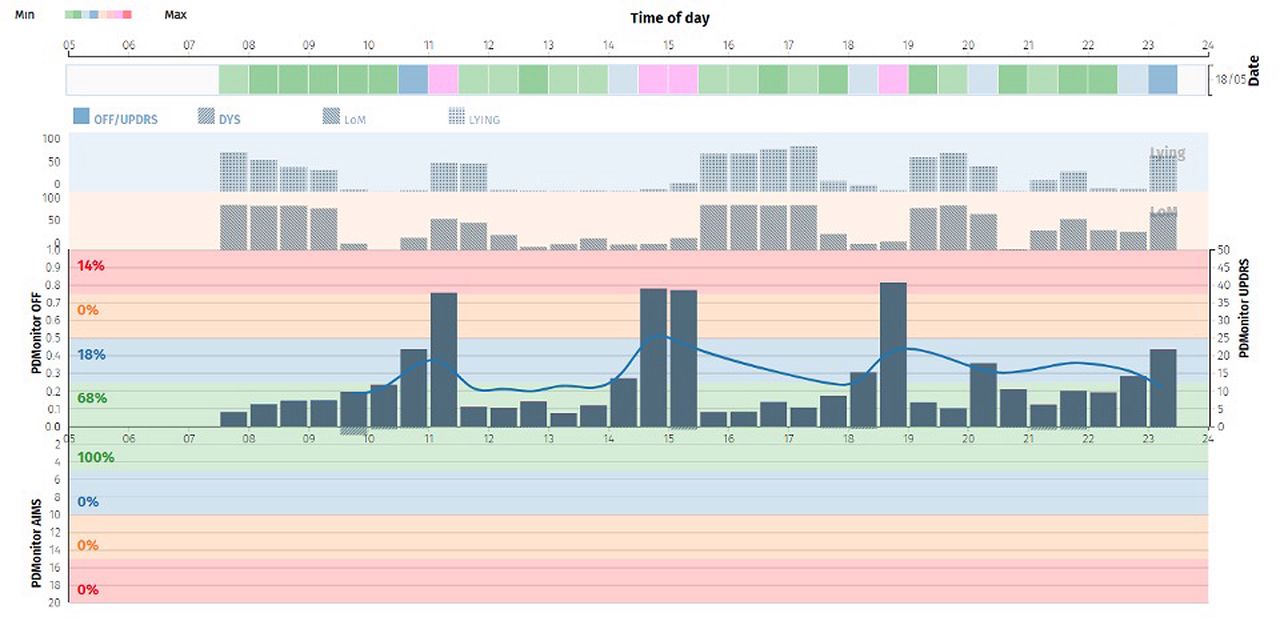
Figure 2.
  • Download figure
  • Open in new tab
  • Download powerpoint
Figure 2.

Report diagram from PDMonitor® showing the total ‘OFF’ score of the patient calculated by the system for a selected period, expressed as a score between 0 and 1. The report shows periods with a high ‘OFF’ score that were highly correlated with exacerbation events reported by the caregiver.

Discussion and Conclusion

The treatment for PD is currently focused on the optimal management of motor and non-motor symptoms, since there is no therapy up to date, with proven efficacy on neuroprotection or modification of disease progression (4). For physicians, accurate information about the symptomatology of the patients throughout the day are indispensable, in order to reach the right treatment decisions (5). Technology-empowered precision medicine is offering nowadays the means for accurate monitoring of the patients and wearable devices are used frequently in the everyday clinical practice (17). During the COVID-19 pandemic, these technologies seem to gain more ground, offering a reliable monitoring remotely, and abridging the time needed for in-person clinical examination (18).

Assessment of symptoms in advanced PD is very often a challenging task, due to the diversity of motor and non-motor symptoms and the rapid transitions between “ON” and “OFF” periods. Besides, the time of in-person clinical evaluation is usually limited, giving only a partial view of the total clinical manifestations, and traditional means like self-reported symptoms, diaries and caregivers’ descriptions, aim to bridge the gap of missing information. However, these means are very often inadequate and even worse, they may mislead physicians, in case of poor descriptions caused by memory limitations, wrong interpretations of the symptoms’ nature, and over- or under-estimation of symptoms due to mood disorders (19).

The two cases presented here are illustrative examples of the potential of a wearable monitoring system to capture accurately the diverse clinical manifestations of advanced PD, reducing the need for prolonged in-person examination or hospitalization. Both cases presented, had significant difficulties in the diagnostic approach posed due to missing information on the time course of symptoms throughout the day. With the use of PDMonitor®, physicians had access to an objective assessment of the patient’s motor symptoms as those manifested in his daily home environment and managed to reach a final diagnosis and make the right treatment decisions.

Footnotes

  • Authors’ Contributions

    K.I.T. collected the data and wrote the manuscript. G.R. and N.K. interpreted the results from the PDMonitor® reports. N.K. reviewed the bibliography and contributed to the discussion of recent references. D.I.F. and S.K. contributed to the writing and reviewed the manuscript.

  • This article is freely accessible online.

  • Conflicts of Interest

    D.I.F. and S.K. are the inventors of PDMonitor® and the founders of PD Neurotechnology Ltd. (the manufacturer of the PDMonitor®). K.I.T., G.R. and N.K. have received salaries from PD Neurotechnology LTD to develop new features for the PDMonitor® and they did not receive any personal or laboratory funding to undertake this study.

  • Received April 16, 2021.
  • Revision received May 3, 2021.
  • Accepted May 4, 2021.
  • Copyright © 2021 The Author(s). Published by the International Institute of Anticancer Research.

References

  1. ↵
    1. Huang J,
    2. Zhou J,
    3. Luo Y,
    4. Yan G,
    5. Liu Y,
    6. Shen Y,
    7. Xu Y,
    8. Li H,
    9. Yan L,
    10. Zhang G,
    11. Fu Y and
    12. Duan H
    : Wrinkle-enabled highly stretchable strain sensors for wide-range health monitoring with a big data cloud platform. ACS Appl Mater Interfaces 12(38): 43009-43017, 2020. PMID: 32856459. DOI: 10.1021/acsami.0c11705
    OpenUrlCrossRefPubMed
  2. ↵
    1. Ye S,
    2. Feng S,
    3. Huang L and
    4. Bian S
    : Recent progress in wearable biosensors: From healthcare monitoring to sports analytics. Biosensors (Basel) 10(12): 205, 2020. PMID: 33333888. DOI: 10.3390/bios10120205
    OpenUrlCrossRefPubMed
  3. ↵
    1. Iijima M,
    2. Mitoma H,
    3. Uchiyama S and
    4. Kitagawa K
    : Long-term monitoring gait analysis using a wearable device in daily lives of patients with Parkinson’s disease: the efficacy of selegiline hydrochloride for gait disturbance. Front Neurol 8: 542, 2017. PMID: 29114238. DOI: 10.3389/fneur.2017.00542
    OpenUrlCrossRefPubMed
  4. ↵
    1. Moore H,
    2. Shpiner DS and
    3. Luca CC
    : Management of motor features in advanced Parkinson disease. Clin Geriatr Med 36(1): 43-52, 2020. PMID: 31733701. DOI: 10.1016/j.cger.2019.09.010
    OpenUrlCrossRefPubMed
  5. ↵
    1. Aradi SD and
    2. Hauser RA
    : Medical management and prevention of motor complications in Parkinson’s disease. Neurotherapeutics 17(4): 1339-1365, 2020. PMID: 32761324. DOI: 10.1007/s13311-020-00889-4
    OpenUrlCrossRefPubMed
  6. ↵
    1. Rastgardani T,
    2. Armstrong MJ,
    3. Gagliardi AR and
    4. Marras C
    : Understanding, impact, and communication of “off” periods in Parkinson’s disease: A scoping review. Mov Disord Clin Pract 5(5): 461-470, 2018. PMID: 30515435. DOI: 10.1002/mdc3.12672
    OpenUrlCrossRefPubMed
  7. ↵
    1. De Marchi F,
    2. Contaldi E,
    3. Magistrelli L,
    4. Cantello R,
    5. Comi C and
    6. Mazzini L
    : Telehealth in neurodegenerative diseases: opportunities and challenges for patients and physicians. Brain Sci 11(2): 237, 2021. PMID: 33668641. DOI: 10.3390/brainsci11020237
    OpenUrlCrossRefPubMed
  8. ↵
    1. Channa A,
    2. Popescu N and
    3. Ciobanu V
    : Wearable solutions for patients with Parkinson’s disease and neurocognitive disorder: a systematic review. Sensors (Basel) 20(9): 2713, 2020. PMID: 32397516. DOI: 10.3390/s20092713
    OpenUrlCrossRefPubMed
  9. ↵
    1. Bayés À,
    2. Samá A,
    3. Prats A,
    4. Pérez-López C,
    5. Crespo-Maraver M,
    6. Moreno JM,
    7. Alcaine S,
    8. Rodriguez-Molinero A,
    9. Mestre B,
    10. Quispe P,
    11. de Barros AC,
    12. Castro R,
    13. Costa A,
    14. Annicchiarico R,
    15. Browne P,
    16. Counihan T,
    17. Lewy H,
    18. Vainstein G,
    19. Quinlan LR,
    20. Sweeney D,
    21. ÓLaighin G,
    22. Rovira J,
    23. Rodrigue Z-Martin D and
    24. Cabestany J
    : A “HOLTER” for Parkinson’s disease: Validation of the ability to detect on-off states using the REMPARK system. Gait Posture 59: 1-6, 2018. PMID: 28963889. DOI: 10.1016/j.gaitpost.2017.09.031
    OpenUrlCrossRefPubMed
  10. ↵
    1. Joshi R,
    2. Bronstein JM,
    3. Keener A,
    4. Alcazar J,
    5. Yang DD,
    6. Joshi M and
    7. Hermanowicz N
    : PKG movement recording system use shows promise in routine clinical care of patients with Parkinson’s disease. Front Neurol 10: 1027, 2019. PMID: 31632333. DOI: 10.3389/fneur.2019.01027
    OpenUrlCrossRefPubMed
  11. ↵
    1. Gao C,
    2. Smith S,
    3. Lones M,
    4. Jamieson S,
    5. Alty J,
    6. Cosgrove J,
    7. Zhang P,
    8. Liu J,
    9. Chen Y,
    10. Du J,
    11. Cui S,
    12. Zhou H and
    13. Chen S
    : Objective assessment of bradykinesia in Parkinson’s disease using evolutionary algorithms: clinical validation. Transl Neurodegener 7: 18, 2018. PMID: 30147869. DOI: 10.1186/s40035-018-0124-x
    OpenUrlCrossRefPubMed
  12. ↵
    1. Höglund A,
    2. Hagell P,
    3. Broman JE,
    4. Pålhagen S,
    5. Sorjonen K,
    6. Fredrikson S and
    7. Svenningsson P
    : Associations between fluctuations in daytime sleepiness and motor and non-motor symptoms in Parkinson’s disease. Mov Disord Clin Pract 8(1): 44-50, 2020. PMID: 33426158. DOI: 10.1002/mdc3.13102
    OpenUrlCrossRefPubMed
  13. ↵
    1. Dorsey ER,
    2. Bloem BR and
    3. Okun MS
    : A New Day: The role of telemedicine in reshaping care for persons with movement disorders. Mov Disord 35(11): 1897-1902, 2020. PMID: 32870517. DOI: 10.1002/mds.28296
    OpenUrlCrossRefPubMed
  14. ↵
    1. Ancona S,
    2. Faraci FD,
    3. Khatab E,
    4. Fiorillo L,
    5. Gnarra O,
    6. Nef T,
    7. Bassetti CLA and
    8. Bargiotas P
    : Wearables in the home-based assessment of abnormal movements in Parkinson’s disease: a systematic review of the literature. J Neurol, 2021. PMID: 33409603. DOI: 10.1007/s00415-020-10350-3
    OpenUrlCrossRefPubMed
  15. ↵
    1. Prasad S,
    2. Holla VV,
    3. Neeraja K,
    4. Surisetti BK,
    5. Kamble N,
    6. Yadav R and
    7. Pal PK
    : Parkinson’s disease and COVID-19: perceptions and implications in patients and caregivers. Mov Disord 35(6): 912-914, 2020. PMID: 32304118. DOI: 10.1002/mds.28088
    OpenUrlCrossRefPubMed
  16. ↵
    1. Motolese F,
    2. Magliozzi A,
    3. Puttini F,
    4. Rossi M,
    5. Capone F,
    6. Karlinski K,
    7. Stark-Inbar A,
    8. Yekutieli Z,
    9. Di Lazzaro V and
    10. Marano M
    : Parkinson’s disease remote patient monitoring during the COVID-19 lockdown. Front Neurol 11: 567413, 2020. PMID: 33117262. DOI: 10.3389/fneur.2020.567413
    OpenUrlCrossRefPubMed
  17. ↵
    1. Gatsios D,
    2. Antonini A,
    3. Gentile G,
    4. Marcante A,
    5. Pellicano C,
    6. Macchiusi L,
    7. Assogna F,
    8. Spalletta G,
    9. Gage H,
    10. Touray M,
    11. Timotijevic L,
    12. Hodgkins C,
    13. Chondrogiorgi M,
    14. Rigas G,
    15. Fotiadis DI and
    16. Konitsiotis S
    : Feasibility and utility of mHealth for the remote monitoring of Parkinson disease: Ancillary study of the PD_manager randomized controlled trial. JMIR Mhealth Uhealth 8(6): e16414, 2020. PMID: 32442154. DOI: 10.2196/16414
    OpenUrlCrossRefPubMed
  18. ↵
    1. Mulroy E,
    2. Menozzi E,
    3. Lees AJ,
    4. Lynch T,
    5. Lang AE and
    6. Bhatia KP
    : Telemedicine in movement disorders: Leçons du COVID-19. Mov Disord 35(11): 1893-1896, 2020. PMID: 32881108. DOI: 10.1002/mds.28297
    OpenUrlCrossRefPubMed
  19. ↵
    1. Armstrong MJ and
    2. Okun MS
    : Diagnosis and treatment of Parkinson disease: a review. JAMA 323(6): 548-560, 2020. PMID: 32044947. DOI: 10.1001/jama.2019.22360
    OpenUrlCrossRefPubMed
PreviousNext
Back to top

In this issue

In Vivo
Vol. 35, Issue 4
July-August 2021
  • Table of Contents
  • Table of Contents (PDF)
  • Index by author
  • Back Matter (PDF)
  • Ed Board (PDF)
  • Front Matter (PDF)
Print
Download PDF
Article Alerts
Sign In to Email Alerts with your Email Address
Email Article

Thank you for your interest in spreading the word on In Vivo.

NOTE: We only request your email address so that the person you are recommending the page to knows that you wanted them to see it, and that it is not junk mail. We do not capture any email address.

Enter multiple addresses on separate lines or separate them with commas.
Accurate Monitoring of Parkinson’s Disease Symptoms With a Wearable Device During COVID-19 Pandemic
(Your Name) has sent you a message from In Vivo
(Your Name) thought you would like to see the In Vivo web site.
CAPTCHA
This question is for testing whether or not you are a human visitor and to prevent automated spam submissions.
1 + 5 =
Solve this simple math problem and enter the result. E.g. for 1+3, enter 4.
Citation Tools
Accurate Monitoring of Parkinson’s Disease Symptoms With a Wearable Device During COVID-19 Pandemic
KONSTANTINOS I. TSAMIS, GEORGE RIGAS, KOSTIKIS NIKOLAOS, DIMITRIOS I. FOTIADIS, SPYRIDON KONITSIOTIS
In Vivo Jul 2021, 35 (4) 2327-2330; DOI: 10.21873/invivo.12507

Citation Manager Formats

  • BibTeX
  • Bookends
  • EasyBib
  • EndNote (tagged)
  • EndNote 8 (xml)
  • Medlars
  • Mendeley
  • Papers
  • RefWorks Tagged
  • Ref Manager
  • RIS
  • Zotero
Reprints and Permissions
Share
Accurate Monitoring of Parkinson’s Disease Symptoms With a Wearable Device During COVID-19 Pandemic
KONSTANTINOS I. TSAMIS, GEORGE RIGAS, KOSTIKIS NIKOLAOS, DIMITRIOS I. FOTIADIS, SPYRIDON KONITSIOTIS
In Vivo Jul 2021, 35 (4) 2327-2330; DOI: 10.21873/invivo.12507
Twitter logo Facebook logo Mendeley logo
  • Tweet Widget
  • Facebook Like
  • Google Plus One

Jump to section

  • Article
    • Abstract
    • Case Presentation
    • Discussion and Conclusion
    • Footnotes
    • References
  • Figures & Data
  • Info & Metrics
  • PDF

Related Articles

Cited By...

  • Barriers to home exercise for patients with Parkinsons disease: a qualitative study
  • Google Scholar

More in this TOC Section

  • Observational Study on the Effectiveness of L-Arginine Plus Vitamin C in the Management of Cancer-related Fatigue
  • Signal Detection Analysis of Hypnotic-induced Respiratory Depression
  • Development and Validation of an EHR-based Algorithm for Identifying Pneumocystis jirovecii Pneumonia
Show more Clinical Studies

Keywords

  • Parkinson’s disease
  • remote monitoring
  • wearables
  • fluctuations
  • objective measurements.
In Vivo

© 2026 In Vivo

Powered by HighWire