
Main menu

  • Home
  • Current Issue
  • Archive
  • Info for
    • Authors
    • Editorial Policies
    • Advertisers
    • Editorial Board
    • Special Issues
  • Journal Metrics
  • Other Publications
    • Anticancer Research
    • Cancer Genomics & Proteomics
    • Cancer Diagnosis & Prognosis
  • More
    • IIAR
    • Conferences
  • About Us
    • General Policy
    • Contact
  • Other Publications
    • In Vivo
    • Anticancer Research
    • Cancer Genomics & Proteomics

User menu

  • Register
  • Subscribe
  • My alerts
  • Log in
  • My Cart

Search

  • Advanced search
In Vivo
  • Other Publications
    • In Vivo
    • Anticancer Research
    • Cancer Genomics & Proteomics
  • Register
  • Subscribe
  • My alerts
  • Log in
  • My Cart
In Vivo

Advanced Search

  • Home
  • Current Issue
  • Archive
  • Info for
    • Authors
    • Editorial Policies
    • Advertisers
    • Editorial Board
    • Special Issues
  • Journal Metrics
  • Other Publications
    • Anticancer Research
    • Cancer Genomics & Proteomics
    • Cancer Diagnosis & Prognosis
  • More
    • IIAR
    • Conferences
  • About Us
    • General Policy
    • Contact
  • Visit iiar on Facebook
  • Follow us on Linkedin
Research ArticleClinical Studies

Impact of Osteopenia on Oncologic Outcomes After Curative Resection for Pancreatic Cancer

TAKASHI MOTOMURA, HIDEAKI UCHIYAMA, TOMOHIRO IGUCHI, MIZUKI NINOMIYA, RINTARO YOSHIDA, TAKUYA HONBOH, NORIAKI SADANAGA, TETSURO AKASHI and HIROSHI MATSUURA
In Vivo November 2020, 34 (6) 3551-3557; DOI: https://doi.org/10.21873/invivo.12198
TAKASHI MOTOMURA
1Department of Surgery, Saiseikai Fukuoka, General Hospital, Fukuoka, Japan
  • Find this author on Google Scholar
  • Find this author on PubMed
  • Search for this author on this site
  • For correspondence: t-moto{at}surg2.med.kyushu-u.ac.jp
HIDEAKI UCHIYAMA
1Department of Surgery, Saiseikai Fukuoka, General Hospital, Fukuoka, Japan
  • Find this author on Google Scholar
  • Find this author on PubMed
  • Search for this author on this site
TOMOHIRO IGUCHI
1Department of Surgery, Saiseikai Fukuoka, General Hospital, Fukuoka, Japan
  • Find this author on Google Scholar
  • Find this author on PubMed
  • Search for this author on this site
MIZUKI NINOMIYA
1Department of Surgery, Saiseikai Fukuoka, General Hospital, Fukuoka, Japan
  • Find this author on Google Scholar
  • Find this author on PubMed
  • Search for this author on this site
RINTARO YOSHIDA
1Department of Surgery, Saiseikai Fukuoka, General Hospital, Fukuoka, Japan
  • Find this author on Google Scholar
  • Find this author on PubMed
  • Search for this author on this site
TAKUYA HONBOH
1Department of Surgery, Saiseikai Fukuoka, General Hospital, Fukuoka, Japan
  • Find this author on Google Scholar
  • Find this author on PubMed
  • Search for this author on this site
NORIAKI SADANAGA
1Department of Surgery, Saiseikai Fukuoka, General Hospital, Fukuoka, Japan
  • Find this author on Google Scholar
  • Find this author on PubMed
  • Search for this author on this site
TETSURO AKASHI
2Department of Internal Medicine, Saiseikai Fukuoka, General Hospital, Fukuoka, Japan
  • Find this author on Google Scholar
  • Find this author on PubMed
  • Search for this author on this site
HIROSHI MATSUURA
1Department of Surgery, Saiseikai Fukuoka, General Hospital, Fukuoka, Japan
  • Find this author on Google Scholar
  • Find this author on PubMed
  • Search for this author on this site
  • Article
  • Figures & Data
  • Info & Metrics
  • PDF
Loading

Abstract

Background/Aim: We evaluated the relationship between low bone mineral density (BMD), also called osteopenia, and prognosis in patients who underwent resection for pancreatic cancer (PC). Patients and Methods: We enrolled 91 consecutive patients who underwent curative resections for PC between May 2009 and January 2019. Their BMDs were measured at the Th11 vertebra using computed tomography. Patients were then divided by age-adjusted standard BMD values into the osteopenia group (n=34) and the non-osteopenia group (n=57). Their overall survival (OS) and recurrence-free survival (RFS) were compared (log-rank test). Results: The two groups did not differ in age, BMI, tumor marker, operation time, blood loss, postoperative complications or stage. The osteopenia group had significantly worse 3-year rates for OS (46% vs. 30%, p=0.04) and RFS (41% vs. 26%, p=0.01). In multivariate analysis, osteopenia was an independent prognostic factor for RFS (HR=2.16, p=0.01). Conclusion: Osteopenia is an adverse prognostic factor for patients with resected PC.

  • Osteopenia
  • pancreatic cancer
  • bone marrow density

Despite improvements in surgical techniques and anti-cancer agents, the prognosis for pancreatic cancer (PC) remains dismal, with a 5-year survival rate of only 8% in the United States (1). Although resection procedures such as pancreaticoduodenectomy (PD) or distal pancreatectomy (DP) are the only curative treatments currently available, their mortality and morbidity rates are ~5% and 30%-60%, respectively (2). Therefore, the decision to perform a resection should be made carefully. In addition to tumor markers and staging, inflammation or immune-nutrition markers such as neutrophil-lymphocyte ratio (NLR) (3, 4), controlling nutritional status (CONUT) score (5), and sarcopenia (6, 7), have been shown to predict prognosis after PC resection. These markers and indices are now widely used for PC and other gastrointestinal and hepatobiliary malignancies (8-10).

Among these nutritional markers, osteopenia, the condition in which bone mineral density (BMD) becomes abnormally low, has recently received attention with respect to hepatobiliary cancer and PC (11-13). Although vitamin D levels are reportedly associated with prognoses of various cancers (14, 15). Sharma et al. have shown for the first time that osteopenia was associated with mortality after liver transplantation for hepatocellular carcinoma (HCC) (11). They measured BMD by calculating average pixel density within a circle of the eleventh thoracic vertebra (Th11), using preoperative CT images.

Using this simple method, Yao et al. have shown an inverse relationship between osteopenia and survival after resection of extrahepatic biliary malignancies (12). However, the effect of osteopenia on prognosis of patients with resected pancreatic malignancies is still unclear. This study aimed to clarify any association between osteopenia and outcomes of resections for PC.

Patients and Methods

Patients. In this study, we retrospectively enrolled 91 consecutive patients who underwent curative resections for PC at our institute between March 2009 and January 2019. The patients' demographics and clinical data were collected from electronic health records. The diagnosis of PC was confirmed by two or more pathologists. The study was approved by the ethical committee of Saiseikai Fukuoka General Hospital.

Detection of osteopenia. BMD was evaluated by preoperative CT images. We used non-contrast CT images at the Th11 level, using the entire vertebra body as the region of interest (ROI), to calculate BMD according to a previous report (Figure 1) (11).

We used two different BMD criteria to determine cut-off values for whether participants were osteopenic or not. The first cut-off value was the median Hounsfield unit (HU) value for the entire study cohort, which was 148 HU; patients whose BMDs were <148 HU or ≥148 HU were considered to be osteopenic or non-osteopenic, respectively.

However, we found that using the median HU score as the cut-off value led to osteopenic and non-osteopenic groups that significantly differed by age, which we considered could confound our evaluation of patient survival and other factors. Therefore, for the second cut-off values, we calculated each patient's age-adjusted standard BMD, as described in our previous report (16), using the following formulae, which were based on data from healthy donors for living-donor liver transplantation: Embedded Image

Thus, we twice divided the participants into two groups–those with osteopenia, and those without osteopenia–using both sets of criteria (Tables I and II).

Measurement of skeletal muscle index. Skeletal muscle area was measured by the same CT images as described above. For the measurement, a transverse CT image at the level of third lumber vertebrae (L3) was chosen as previously described (10). All the skeletal muscle in the L3 region was quantified by manual tracing, including the psoas, the erector spinae, the quadratus lumborum, the transversus abdominis, the external and the internal oblique abdominal muscle, and the rectus abdominis muscle. Because this area is related to each patient's physical size, the measured skeletal muscle area was normalized to the patient's height (skeletal muscle index; SMI, cm2/m2).

Measurement of NLR and CONUT score. According to previous reports (3-5), NLR was calculated by dividing neutrophil counts by lymphocyte counts, using preoperative laboratory data. Similarly, CONUT scores were calculated by adding scores for albumin concentrations, lymphocyte counts and total cholesterol concentrations (albumin concentrations of ≥3.5, 3.0-3.49, 2.5-2.99 and <2.5 g/dl were scored as 0, 2, 4, and 6 points, respectively; total lymphocyte counts of ≥1600, 1200-1599, 800-1199 and <800/mm3 were scored as 0, 1, 2 and 3 points, respectively; and total cholesterol concentrations ≥180, 140-179, 100-139 and <100 mg/dl were scored as 0, 1, 2, 3, respectively).

Statistical analysis. All data were analyzed using JMP® statistical software (SAS Institute, Cary, NC, USA). A χ2 test was performed for qualitative variables, and a Wilcoxon test was performed for quantitative variables. A log-rank test was performed for survival rates using the Kaplan-Meier method.

Results

Comparison of patients' characteristics according to median BMD value. Patients were initially divided into two groups according to the median BMD value, 148 HU. Table I shows the clinicopathological factors of these two groups. The mean age of the osteopenia group (n=45) was significantly higher than that of the non-osteopenia group (n=46) (75 vs. 68, p=0.001). The osteopenia group also had a lower mean hemoglobin level (12.2 vs. 13.0, p=0.01). Thirty osteopenia patients and 31 non-osteopenia patients had tubular adenocarcinoma; other patients had adenosquamous carcinoma, acinar cell carcinoma, malignant mucinous cystic neoplasm, or neuroendocrine carcinoma. The two groups did not significantly differ in tumor pathology or staging. However, a significantly lower percentage of the osteopenia group underwent post-operative adjuvant chemotherapy.

Figure 1.
  • Download figure
  • Open in new tab
  • Download powerpoint
Figure 1.

Non-contrast CT image at the level of Th11. A region of interest (ROI) was traced, free-hand, along the vertebra body; the mean value of density was then provided in Hounsfield units (HU).

Three-years OS and RFS were both significantly worse in the osteopenia group (OS rate: 47.6% vs. 26.6%, p=0.006; RFS rate: 45.4% vs. 25.8%, p=0.008).

However, as differences in age could influence these results, we evaluated the participants again, following categorization according to their age-adjusted standard BMD.

Comparison of patients' characteristics by their age-adjusted standard BMD. To decrease the influence of age on our findings, we calculated the standard age-adjusted BMD for each patient as previously described (16). Patients whose BMDs were less than their age-adjusted standard values were considered to have osteopenia. Table II shows the clinicopathological factors of the age-adjusted osteopenia group (n=34) and non-osteopenia group (n=57). The two groups did not significantly differ in age, tumor pathology or staging, or other clinical factors. However, mean hemoglobin levels were again lower in the osteopenia group (12.1 vs. 13.0, p=0.006).

Among immune and inflammatory-nutritional markers, SMI tended to be lower in the age-adjusted osteopenia group, but not significantly so. Mean NLR, CRP and CONUT scores did not significantly differ between the two age-adjusted groups.

View this table:
  • View inline
  • View popup
  • Download powerpoint
Table I.

Clinicopathological factors of patients with and without osteopenia, using median BMD (148 HU) as the cut-off.

Survival rate with or without age-adjusted osteopenia. Three-year OS was 46% in the non-age-adjusted osteopenia group and 30% in the age-adjusted osteopenia group (p=0.04; Figure 2A). This difference was even more pronounced for the 3-year RFS in the non-age-adjusted osteopenia group (41%) than in the age-adjusted osteopenia group (26%, p=0.01; Figure 2B). These findings suggest that, rather than an unrelated comorbidity, or nonspecific indicator of impaired general condition, osteopenia is significantly associated with cancer recurrence

In univariate analysis, age-adjusted osteopenia, tumor differentiation, anterior surface invasion, retroperitoneum invasion, portal vein invasion, nerve plexus invasion and lymph node metastasis were associated with shorter RFS after resection for PC (Table III). Multivariate analysis found age-adjusted osteopenia to be independently associated with worse RFS after resection for PC.

Discussion

This study shows, for the first time, that osteopenia has a negative impact on long-term outcomes after curative resection for malignant pancreatic tumors.

At first, we set the cut-off value for BMD at 148 HU–the median value for our study cohort. Although the osteopenia group exhibited worse outcomes, we could not deny the possibility of confounding bias due to the significant difference in age between the two groups. We, therefore, calculated age-adjusted standard BMD values for each patient, according to a formula that was established using data from healthy living organ donors (16). The age-adjusted osteopenia group still showed worse OS and RFS. Our findings imply that osteopenia is not merely a comorbidity but is associated with cancer recurrence among patients with pancreatic malignancies.

View this table:
  • View inline
  • View popup
  • Download powerpoint
Table II.

Clinicopathological factors of patients with and without osteopenia, using age-adjusted standard BMD values as the cut-off.

Sarcopenia and frailty have recently received much attention among clinical oncologists, but the role of osteopenia in oncologic outcomes is less widely studied. As decreased BMD is associated with menopause and anti-estrogen treatments, breast oncologists may pay more attention to osteopenia; several reports have shown a correlation between osteopenia and breast cancer prognosis (17, 18). Similarly, osteopenia has also been reported during anti-androgen therapy for prostate cancer patients (19).

The European Society of Medical Oncology has published a guideline for managing bone health in cancer patients (20). This guideline, however, first addresses the management of patients with bone metastasis arising from various solid tumors. Secondly, the guideline addresses the negative effects of anti-cancer therapies (such as chemotherapy and radiation) on reproductive hormones that are crucial for the maintenance of bone remodeling. The study of Dumanskiy et al. on bone metabolism in lung cancer patients has shown that they had significantly higher serum levels of some macro- and microelements (such as cobalt, lithium, and phosphorus) compared with healthy controls (21). Conversely, calcium and magnesium were significantly lower. These findings may reflect abnormal bone metabolism associated with osteopenia and osteoporosis in various cancers, which often result in bone fractures, and negatively impact patients' quality of life. However, this report did not show correlations with long-term survival, or with cancer recurrence.

Interestingly, the correlation of osteopenia with poor cancer prognosis after resection has been reported for HCC (11), and biliary cancer (12), in addition to breast cancer. To our knowledge, the current study is the first to show an association of osteopenia with worse survival after PC resection Although the mechanism of this relationship is unclear, osteopenia might be associated with some inflammatory cytokines, as with sarcopenia (22). However, whether osteopenia is the result of advanced malignancy or the cause of worse prognosis is unclear. In the current study, age-adjusted osteopenia was inversely associated with both OS and RFS, which strongly suggests that osteopenia is not simply the result of a systemic impairment (such as cachexia) but is associated with some tumor factors.
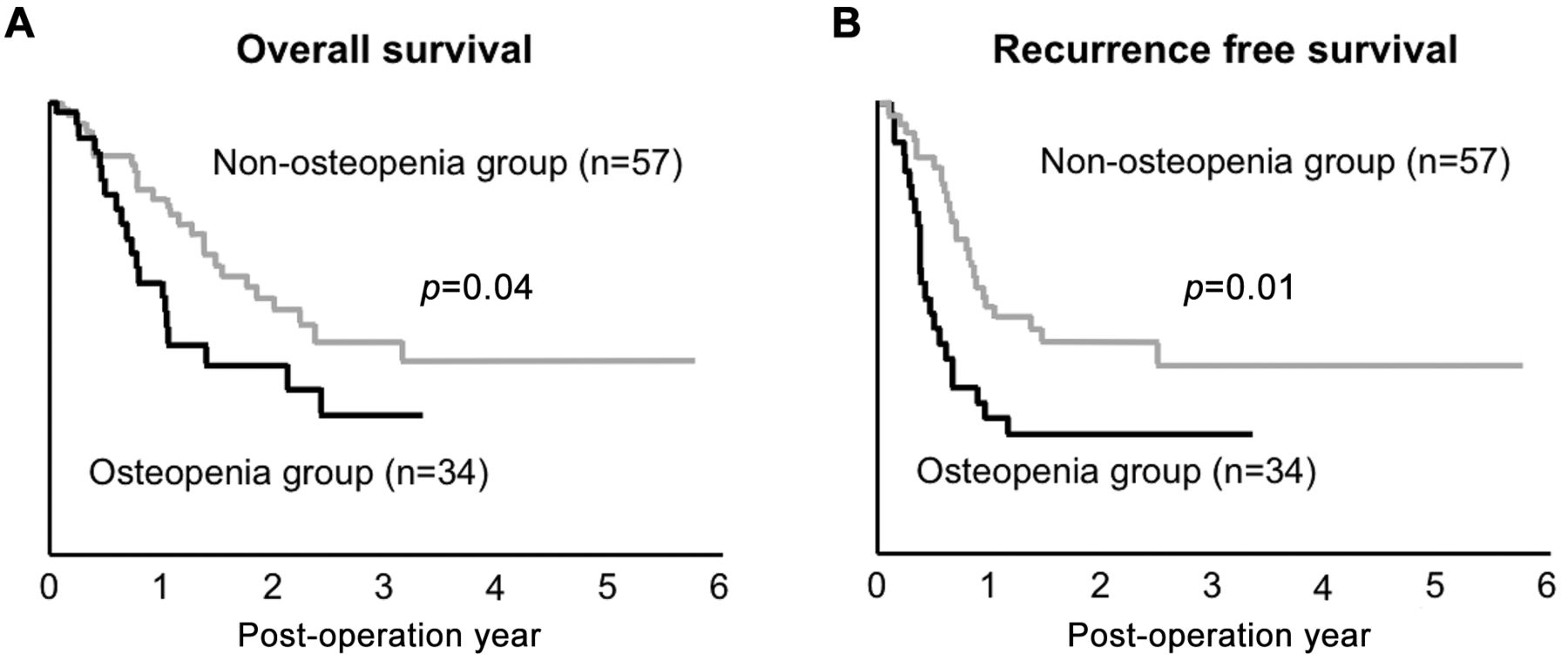
Figure 2.
  • Download figure
  • Open in new tab
  • Download powerpoint
Figure 2.

Comparison of overall survival (OS) and recurrence-free survival (RFS) rates between patients with osteopenia and those without osteopenia (age-adjusted). (A) OS was significantly worse in osteopenia group; and (B) age-adjusted osteopenia was a significant risk factor for pancreatic cancer recurrence.

View this table:
  • View inline
  • View popup
  • Download powerpoint
Table III.

Univariate and multivariate analyses of factors that affect pancreatic cancer recurrence after curative resection.

Qiu et al. have shown the NF-ĸB is possibly the cause of sarcopenia (23). Interestingly, high expression of receptor activator of NF-ĸB ligand (RANKL) has recently been reported to increase the risk of bone metastasis in breast cancer patients (24). NF-ĸB is reportedly a key molecule in the progression of both biliary cancer and PC (25-27). Together, these findings suggest that NF-ĸB could affect the relationships between sarcopenia and osteopenia and poor prognosis of biliary cancer and PC.

Therapeutic management of osteopenia warrants wider attention. A bisphosphonate, zoledronate, has shown to prevent fractures in women with osteopenia (28). Surprisingly, this bisphosphonate also improved survival in breast cancer patients when used as an adjuvant therapy (29). Although bisphosphonates could not be concluded to lengthen OS or RFS in patients with PC, their involvement should be studied further.

This study is limited by its retrospective, single-center design and its small cohort. Age-adjustment for BMD decreased the age-related bias for osteopenia outcomes, but sex and hemoglobin levels may still be confounding factors. The percentage of patients who underwent adjuvant chemotherapy tended to be smaller in the osteopenia group, but not significantly so. However, multivariate analysis still demonstrated the significance of age-adjusted osteopenia for cancer recurrence.

In conclusion, this is the first report to show that age-adjusted osteopenia is associated with worse prognosis after resection for PC, which suggests that monitoring bone density might be a useful tool in managing this most challenging disease.

Acknowledgements

The Authors thank Marla Brunker, from Edanz Group (www.edanzediting.com/ac), for editing a draft of this manuscript.

Footnotes

  • Authors' Contributions

    Takashi Motomura performed the operations, collected and analyzed the data, wrote and edited the manuscript. Hideaki Uchiyama performed the operations, checked and revised the manuscript. Tomohiro Iguchi checked and revised the manuscript. Mizuki Ninomiya performed the operations and collected the data. Rintaro Yoshida performed the operations. Takuya Honboh performed the operations. Noriaki Sadanaga performed the operations and checked the manuscript. Tetsuro Akashi tested and diagnosed the patients. Hiroshi Matsuura supervised the entire work.

  • This article is freely accessible online.

  • Conflicts of Interest

    The Authors of this manuscript declare that they have no competing interests regarding this work.

  • Received August 25, 2020.
  • Revision received September 28, 2020.
  • Accepted September 29, 2020.
  • Copyright © 2020 The Author(s). Published by the International Institute of Anticancer Research.

References

  1. ↵
    1. Siegel RL,
    2. Miller KD,
    3. Jemal A
    : Cancer statistics 2018. CA Cancer J Clin 68(1): 7-30, 2018. PMID: 29313949. DOI: 10.3322/caac.21442
    OpenUrlCrossRefPubMed
  2. ↵
    1. Khalili M,
    2. Morano WF,
    3. Marconcini L,
    4. Shaikh MF,
    5. Gleeson EM,
    6. Styler M,
    7. Zebrower M,
    8. Bowne WB
    : Multidisciplinary strategies in bloodless medicine and surgery for patients undergoing pancreatectomy. J Surg Res 229: 208e215, 2018. PMID: 29936992. DOI: 10.1016/j.jss.2018.04.009
    OpenUrl
  3. ↵
    1. Tsujita E,
    2. Ikeda Y,
    3. Kinjo N,
    4. Yamashita YI,
    5. Hisano T,
    6. Furukawa M,
    7. Taguchi KI,
    8. Morita M,
    9. Toh Y,
    10. Okamura T
    : Postoperative neutrophil-to-lymphocyte ratio as a predictor of long-term prognosis after pancreatectomy for pancreatic carcinoma: a retrospective analysis. Am Surg 83(6): 610-616, 2017. PMID: 28637563.
    OpenUrl
  4. ↵
    1. Abe T,
    2. Nakata K,
    3. Kibe S,
    4. Mori Y,
    5. Miyasaka Y,
    6. Ohuchida K,
    7. Ohtsuka T,
    8. Oda Y,
    9. Nakamura M
    : Prognostic value of preoperative nutritional and immunological factors in patients with pancreatic ductal adenocarcinoma. Ann Surg Oncol 25(13): 3996-4003, 2018. PMID: 30225838. DOI: 10.1245/s10434-018-6761-6
    OpenUrl
  5. ↵
    1. Kato Y,
    2. Yamada S,
    3. Suenaga M,
    4. Takami H,
    5. Niwa Y,
    6. Hayashi M,
    7. Iwata N,
    8. Kanda M,
    9. Tanaka C,
    10. Nakayama G,
    11. Koike M,
    12. Fujiwara M,
    13. Kodera Y
    : Impact of the controlling nutritional status score on the prognosis after curative resection of pancreatic ductal adenocarcinoma. Pancreas 47(7): 823-829, 2018. PMID: 29975352. DOI: 10.1097/MPA.0000000000001105
    OpenUrl
  6. ↵
    1. Peng P,
    2. Hyder O,
    3. Firoozmand A,
    4. Kneuertz P,
    5. Schulick RD,
    6. Huang D,
    7. Makary M,
    8. Hirose K,
    9. Edil B,
    10. Choti MA,
    11. Herman J,
    12. Cameron JL,
    13. Wolfgang CL,
    14. Pawlik TM
    : Impact of sarcopenia on outcomes following resection of pancreatic adenocarcinoma J Gastrointest Surg 16(8): 1478-1486, 2012. PMID: 22692586. DOI: 10.1007/s11605-012-1923-5
    OpenUrlCrossRefPubMed
  7. ↵
    1. Mintziras I,
    2. Miligkos M,
    3. Wächter S,
    4. Manoharan J,
    5. Maurer E,
    6. Bartsch DK
    : Sarcopenia and sarcopenic obesity are significantly associated with poorer overall survival in patients with pancreatic cancer: Systematic review and meta-analysis. Int J Surg 59: 19-26, 2018. PMID: 30266663. DOI: 10.1016/j.ijsu.2018.09.014
    OpenUrl
  8. ↵
    1. Motomura T,
    2. Shirabe K,
    3. Mano Y,
    4. Muto J,
    5. Toshima T,
    6. Umemoto Y,
    7. Fukuhara T,
    8. Uchiyama H,
    9. Ikegami T,
    10. Yoshizumi T,
    11. Soejima Y,
    12. Maehara Y
    : Neutrophil-lymphocyte ratio reflects hepatocellular carcinoma recurrence after liver transplantation via inflammatory microenvironment. J Hepatol 58(1): 58-64, 2013. PMID: 22925812. DOI: 10.1016/j.jhep.2012.08.017
    OpenUrlCrossRefPubMed
    1. Harimoto N,
    2. Yoshizumi T,
    3. Inokuchi S,
    4. Itoh S,
    5. Adachi E,
    6. Ikeda Y,
    7. Uchiyama H,
    8. Utsunomiya T,
    9. Kajiyama K,
    10. Kimura K,
    11. Kishihara F,
    12. Sugimachi K,
    13. Tsujita E,
    14. Ninomiya M,
    15. Fukuzawa K,
    16. Maeda T,
    17. Shirabe K,
    18. Maehara Y
    : Prognostic significance of preoperative controlling nutritional status (conut) score in patients undergoing hepatic resection for hepatocellular carcinoma: a multi-institutional study. Ann Surg Oncol 25(11): 3316-3323, 2018. PMID: 30051372. DOI: 10.1245/s10434-018-6672-6
    OpenUrl
  9. ↵
    1. Harimoto N,
    2. Shirabe K,
    3. Yamashita YI,
    4. Ikegami T,
    5. Yoshizumi T,
    6. Soejima Y,
    7. Ikeda T,
    8. Maehara Y,
    9. Nishie A,
    10. Yamanaka T
    : Sarcopenia as a predictor of prognosis in patients following hepatectomy for hepatocellular carcinoma. Br J Surg 100(11): 1523-1530, 2013. PMID: 24037576. DOI: 10.1002/bjs.9258
    OpenUrlCrossRefPubMed
  10. ↵
    1. Sharma P,
    2. Parikh ND,
    3. Yu J,
    4. Barman P,
    5. Derstine BA,
    6. Sonnenday CJ,
    7. Wang SC,
    8. Su GL
    : Bone mineral density predicts posttransplant survival among hepatocellular carcinoma liver transplant recipients. Liver Transpl 22(8): 1092-1098, 2016. PMID: 27064263. DOI: 10.1002/lt.24458
    OpenUrl
  11. ↵
    1. Yao S,
    2. Kaido T,
    3. Okumura S,
    4. Iwamura S,
    5. Miyachi Y,
    6. Shirai H,
    7. Kobayashi A,
    8. Hamaguchi Y,
    9. Kamo N,
    10. Uozumi R,
    11. Yagi S,
    12. Uemoto S
    : Bone mineral density correlates with survival after resection of extrahepatic biliary malignancies. Clin Nutr 38(6): 2770-2777, 2019. PMID: 30595376. DOI: 10.1016/j.clnu.2018.12.004
    OpenUrl
  12. ↵
    1. Yamada D,
    2. Eguchi H,
    3. Iwagami Y,
    4. Mukai Y,
    5. Hashimoto Y,
    6. Asaoka T,
    7. Noda T,
    8. Kawamoto K,
    9. Gotoh K,
    10. Kobayashi S,
    11. Takeda Y,
    12. Tanemura M,
    13. Mori M,
    14. Doki Y
    : Patients treated with preoperative chemoradiation for pancreatic ductal adenocarcinoma have impaired bone density, a predictor of distant metastasis. Ann Surg Oncol 24(12): 3715-3724, 2017. PMID: 28849575. DOI: 10.1245/s10434-017-6040-y
    OpenUrl
  13. ↵
    1. Ma Y,
    2. Zhang P,
    3. Wang F,
    4. Yang J,
    5. Liu Z,
    6. Qin H
    : Association between vitamin D and risk of colorectal cancer: a systematic review of prospective studies. J Clin Oncol 29(28): 3775-3782, 2011. PMID: 21876081. DOI: 10.1200/JCO.2011.35.7566
    OpenUrlAbstract/FREE Full Text
  14. ↵
    1. Fedirko V,
    2. Duarte-Salles T,
    3. Bamia C,
    4. Trichopoulou A,
    5. Aleksandrova K,
    6. Trichopoulos D,
    7. Trepo E,
    8. Tjønneland A,
    9. Olsen A,
    10. Overvad K,
    11. Boutron-Ruault MC,
    12. Clavel-Chapelon F,
    13. Kvaskoff M,
    14. Kühn T,
    15. Lukanova A,
    16. Boeing H,
    17. Buijsse B,
    18. Klinaki E,
    19. Tsimakidi C,
    20. Naccarati A,
    21. Tagliabue G,
    22. Panico S,
    23. Tumino R,
    24. Palli D,
    25. Bueno-de-Mesquita HB,
    26. Siersema PD,
    27. Peters PH,
    28. Lund E,
    29. Brustad M,
    30. Olsen KS,
    31. Weiderpass E,
    32. Zamora-Ros R,
    33. Sánchez MJ,
    34. Ardanaz E,
    35. Amiano P,
    36. Navarro C,
    37. Quirós JR,
    38. Werner M,
    39. Sund M,
    40. Lindkvist B,
    41. Malm J,
    42. Travis RC,
    43. Khaw KT,
    44. Stepien M,
    45. Scalbert A,
    46. Romieu I,
    47. Lagiou P,
    48. Riboli E,
    49. Jenab M
    : Prediagnostic circulating vitamin D levels and risk of hepatocellular carcinoma in European populations: a nested case-control study. Hepatology 60(4): 1222-1230, 2014. PMID: 24644045. DOI: 10.1002/hep.27079
    OpenUrlCrossRefPubMed
  15. ↵
    1. Toshima T,
    2. Yoshizumi T,
    3. Ikegami T,
    4. Harada N,
    5. Itoh S,
    6. Mano Y,
    7. Motomura T,
    8. Soejima Y,
    9. Maehara Y
    : Impact of osteopenia in liver cirrhosis: special reference to standard bone mineral density with age. Anticancer Res 38(11): 6465-6471, 2018. PMID: 30396973. DOI: 10.21873/anticanres.13009
    OpenUrlAbstract/FREE Full Text
  16. ↵
    1. Ramin C,
    2. May BJ,
    3. Roden RBS,
    4. Orellana MM,
    5. Hogan BC,
    6. McCullough MS,
    7. Petry D,
    8. Armstrong DK,
    9. Visvanathan K
    : Evaluation of osteopenia and osteoporosis in younger breast cancer survivors compared with cancer-free women: a prospective cohort study. Breast Cancer Res 20(1): 134, 2018. PMID: 30424783. DOI: 10.1186/s13058-018-1061-4
    OpenUrl
  17. ↵
    1. Lumachi F,
    2. Basso SMM,
    3. Camozzi V,
    4. Spaziante R,
    5. Ubiali P,
    6. Ermani M
    : Bone mineral density as a potential predictive factor for luminal-type breast cancer in postmenopausal women. Anticancer Res 38(5): 3049-3054, 2018. PMID: 29715139. DOI: 10.21873/anticanres.12561
    OpenUrlAbstract/FREE Full Text
  18. ↵
    1. Poulsen MH,
    2. Frost M,
    3. Abrahamsen B,
    4. Gerke O,
    5. Walter S,
    6. Lund L
    : Osteoporosis and prostate cancer; a 24-month prospective observational study during androgen deprivation therapy. Scand J Urol 53(1): 34-39, 2019. PMID: 30777478. DOI: 10.1080/21681805.2019.1570328
    OpenUrl
  19. ↵
    1. Coleman R,
    2. Body JJ,
    3. Aapro M,
    4. Hadji P,
    5. Herrstedt J,
    6. ESMO Guidelines Working Group
    : Bone health in cancer patients: ESMO Clinical Practice Guidelines. Ann Oncol 25: iii124-37, 2014. PMID: 24782453. DOI: 10.1093/annonc/mdu103
    OpenUrlCrossRefPubMed
  20. ↵
    1. Dumanskiy YV,
    2. Syniachenko OV,
    3. Stepko PA,
    4. Taktashov GS,
    5. Chernyshova OY,
    6. Stoliarova OY
    : The state of bone metabolism in lung cancer patients. Exp Oncol 40(2): 136-139, 2018. PMID: 29949526.
    OpenUrl
  21. ↵
    1. Li CW,
    2. Yu K,
    3. Shyh-Chang N,
    4. Li GX,
    5. Jiang LJ,
    6. Yu SL,
    7. Xu LY,
    8. Liu RJ,
    9. Guo ZJ,
    10. Xie HY,
    11. Li RR,
    12. Ying J,
    13. Li K,
    14. Li DJ
    : Circulating factors associated with sarcopenia during ageing and after intensive lifestyle intervention. J Cachexia Sarcopenia Muscle 10(3): 586-600, 2019. PMID: 30969486. DOI: 10.1002/jcsm.12417
    OpenUrl
  22. ↵
    1. Qiu J,
    2. Thapaliya S,
    3. Runkana A,
    4. Yang Y,
    5. Tsien C,
    6. Mohan ML,
    7. Narayanan A,
    8. Eghtesad B,
    9. Mozdziak PE,
    10. McDonald C,
    11. Stark GR,
    12. Welle S,
    13. Naga Prasad SV,
    14. Dasarathy S
    : Hyperammonemia in cirrhosis induces transcriptional regulation of myostatin by an NF-ĸB-mediated mechanism. Proc Natl Acad Sci USA 110(45): 18162-18167, 2013. PMID: 24145431. DOI: 10.1073/pnas.1317049110
    OpenUrlAbstract/FREE Full Text
  23. ↵
    1. Rachner TD,
    2. Kasimir-Bauer S,
    3. Göbel A,
    4. Erdmann K,
    5. Hoffmann O,
    6. Browne A,
    7. Wimberger P,
    8. Rauner M,
    9. Hofbauer LC,
    10. Kimmig R,
    11. Bittner AK
    : Prognostic value of RANKL/OPG serum levels and disseminated tumor cells in nonmetastatic breast cancer. Clin Cancer Res 25(4): 1369-1378, 2019. PMID: 30425091. DOI: 10.1158/1078-0432.CCR-18-2482
    OpenUrlAbstract/FREE Full Text
  24. ↵
    1. Sclabas GM,
    2. Fujioka S,
    3. Schmidt C,
    4. Evans DB,
    5. Chiao PJ
    : NF-ĸB in pancreatic cancer. Int J Gastrointest Cancer 33(1): 15-26, 2003. PMID: 12909735. DOI: 10.1385/IJGC:33:1:15
    OpenUrlCrossRefPubMed
    1. Srikoon P,
    2. Kariya R,
    3. Kudo E,
    4. Goto H,
    5. Vaeteewoottacharn K,
    6. Taura M,
    7. Wongkham S,
    8. Okada S
    : Diethyldithiocarbamate suppresses an NF-ĸB dependent metastatic pathway in cholangiocarcinoma cells. Asian Pac J Cancer Prev 14(7): 4441-4446, 2013. PMID: 23992017. DOI: 10.7314/apjcp.2013.14.7.4441
    OpenUrlCrossRefPubMed
  25. ↵
    1. Furukawa K,
    2. Uwagawa T,
    3. Haruki K,
    4. Fujiwara Y,
    5. Iida T,
    6. Shiba H,
    7. Misawa T,
    8. Ohashi T,
    9. Yanaga K
    : Nuclear factor ĸB activity correlates with the progression and prognosis of pancreatic cancer in a mouse model. Surg Today 43(2): 171-177, 2013. PMID: 22892758. DOI: 10.1007/s00595-012-0279-5
    OpenUrl
  26. ↵
    1. Reid IR,
    2. Horne AM,
    3. Mihov B,
    4. Stewart A,
    5. Garratt E,
    6. Wong S,
    7. Wiessing KR,
    8. Bolland MJ,
    9. Bastin S,
    10. Gamble GD
    : Fracture prevention with zoledronate in older women with osteopenia. N Engl J Med 379(25): 2407-2416, 2018. PMID: 22892758. DOI: 10.1007/s00595-012-0279-5
    OpenUrlCrossRefPubMed
  27. ↵
    1. Gnant M,
    2. Mlineritsch B,
    3. Stoeger H,
    4. Luschin-Ebengreuth G,
    5. Heck D,
    6. Menzel C,
    7. Jakesz R,
    8. Seifert M,
    9. Hubalek M,
    10. Pristauz G,
    11. Bauernhofer T,
    12. Eidtmann H,
    13. Eiermann W,
    14. Steger G,
    15. Kwasny W,
    16. Dubsky P,
    17. Hochreiner G,
    18. Forsthuber EP,
    19. Fesl C,
    20. Greil R
    : Adjuvant endocrine therapy plus zoledronic acid in premenopausal women with early-stage breast cancer: 62-month follow-up from the ABCSG-12 randomised trial. Lancet Oncol 12(7): 631-641, 2011. PMID: 21641868. DOI: 10.1016/S1470-2045(11)70122-X
    OpenUrlCrossRefPubMed
PreviousNext
Back to top

In this issue

In Vivo
Vol. 34, Issue 6
November-December 2020
  • Table of Contents
  • Table of Contents (PDF)
  • Index by author
  • Back Matter (PDF)
  • Ed Board (PDF)
  • Front Matter (PDF)
Print
Download PDF
Article Alerts
Sign In to Email Alerts with your Email Address
Email Article

Thank you for your interest in spreading the word on In Vivo.

NOTE: We only request your email address so that the person you are recommending the page to knows that you wanted them to see it, and that it is not junk mail. We do not capture any email address.

Enter multiple addresses on separate lines or separate them with commas.
Impact of Osteopenia on Oncologic Outcomes After Curative Resection for Pancreatic Cancer
(Your Name) has sent you a message from In Vivo
(Your Name) thought you would like to see the In Vivo web site.
CAPTCHA
This question is for testing whether or not you are a human visitor and to prevent automated spam submissions.
7 + 1 =
Solve this simple math problem and enter the result. E.g. for 1+3, enter 4.
Citation Tools
Impact of Osteopenia on Oncologic Outcomes After Curative Resection for Pancreatic Cancer
TAKASHI MOTOMURA, HIDEAKI UCHIYAMA, TOMOHIRO IGUCHI, MIZUKI NINOMIYA, RINTARO YOSHIDA, TAKUYA HONBOH, NORIAKI SADANAGA, TETSURO AKASHI, HIROSHI MATSUURA
In Vivo Nov 2020, 34 (6) 3551-3557; DOI: 10.21873/invivo.12198

Citation Manager Formats

  • BibTeX
  • Bookends
  • EasyBib
  • EndNote (tagged)
  • EndNote 8 (xml)
  • Medlars
  • Mendeley
  • Papers
  • RefWorks Tagged
  • Ref Manager
  • RIS
  • Zotero
Reprints and Permissions
Share
Impact of Osteopenia on Oncologic Outcomes After Curative Resection for Pancreatic Cancer
TAKASHI MOTOMURA, HIDEAKI UCHIYAMA, TOMOHIRO IGUCHI, MIZUKI NINOMIYA, RINTARO YOSHIDA, TAKUYA HONBOH, NORIAKI SADANAGA, TETSURO AKASHI, HIROSHI MATSUURA
In Vivo Nov 2020, 34 (6) 3551-3557; DOI: 10.21873/invivo.12198
Twitter logo Facebook logo Mendeley logo
  • Tweet Widget
  • Facebook Like
  • Google Plus One

Jump to section

  • Article
    • Abstract
    • Patients and Methods
    • Results
    • Discussion
    • Acknowledgements
    • Footnotes
    • References
  • Figures & Data
  • Info & Metrics
  • PDF

Related Articles

Cited By...

  • Prognostic Relationship Between the Cachexia Index and Osteopenia in Patients With Pancreatic Cancer
  • Preoperative Vertebral Fracture: A Prognostic Factor in Stage I-III Colorectal Cancer
  • Association Between Preoperative Osteopenia and Prognosis in Breast Cancer Patients
  • Preoperative Osteopenia as Risk Factor for Death from Other Diseases After Gastrectomy in Elderly Patients
  • Preoperative Osteopenia Is a Risk Factor for Death in Patients Undergoing Gastrectomy for Gastric Cancer
  • Impact of Osteopenia on Pancreatic Fistula in Patients Undergoing Pancreaticoduodenectomy
  • Google Scholar

More in this TOC Section

  • Association Between Dipeptidyl Peptidase-4 Inhibitor Use and Acute Kidney Injury in Patients With Diabetes Mellitus: A Disproportionality Analysis Based on the FAERS
  • Older Age and Outcomes of Intravesical Bacillus Calmette-Guérin for Non-muscle-invasive Bladder Cancer
  • Expression Patterns of T-cell immunoreceptor With Ig and ITIM domains (TIGIT) in Classical Hodgkin Lymphoma: A Clinicopathological Study
Show more Clinical Studies

Keywords

  • osteopenia
  • Pancreatic cancer
  • bone marrow density
In Vivo

© 2026 In Vivo

Powered by HighWire