Main menu

  • Home
  • Current Issue
  • Archive
  • Info for
    • Authors
    • Editorial Policies
    • Advertisers
    • Editorial Board
    • Special Issues
  • Journal Metrics
  • Other Publications
    • Anticancer Research
    • Cancer Genomics & Proteomics
    • Cancer Diagnosis & Prognosis
  • More
    • IIAR
    • Conferences
  • About Us
    • General Policy
    • Contact
  • Other Publications
    • In Vivo
    • Anticancer Research
    • Cancer Genomics & Proteomics

User menu

  • Register
  • Subscribe
  • My alerts
  • Log in
  • My Cart

Search

  • Advanced search
In Vivo
  • Other Publications
    • In Vivo
    • Anticancer Research
    • Cancer Genomics & Proteomics
  • Register
  • Subscribe
  • My alerts
  • Log in
  • My Cart
In Vivo

Advanced Search

  • Home
  • Current Issue
  • Archive
  • Info for
    • Authors
    • Editorial Policies
    • Advertisers
    • Editorial Board
    • Special Issues
  • Journal Metrics
  • Other Publications
    • Anticancer Research
    • Cancer Genomics & Proteomics
    • Cancer Diagnosis & Prognosis
  • More
    • IIAR
    • Conferences
  • About Us
    • General Policy
    • Contact
  • Visit iiar on Facebook
  • Follow us on Linkedin
Research ArticleExperimental Studies

Anti-UV Activity of Newly-synthesized Water-soluble Azulenes

JUN-ICHI UEKI, HIROSHI SAKAGAMI and HIDETSUGU WAKABAYASHI
In Vivo January 2013, 27 (1) 119-126;
JUN-ICHI UEKI
1Faculty of Science, Josai University, Sakado, Japan
  • Find this author on Google Scholar
  • Find this author on PubMed
  • Search for this author on this site
HIROSHI SAKAGAMI
2Division of Pharmacology, Meikai University School of Dentistry, Sakado, Japan
  • Find this author on Google Scholar
  • Find this author on PubMed
  • Search for this author on this site
  • For correspondence: hwaka{at}josai.ac.jp sakagami{at}dent.meikai.ac.jp
HIDETSUGU WAKABAYASHI
1Faculty of Science, Josai University, Sakado, Japan
  • Find this author on Google Scholar
  • Find this author on PubMed
  • Search for this author on this site
  • For correspondence: hwaka{at}josai.ac.jp sakagami{at}dent.meikai.ac.jp
  • Article
  • Figures & Data
  • Info & Metrics
  • PDF
Loading

Article Figures & Data

Figures

  • Tables
  • Figure 1.
    • Download figure
    • Open in new tab
    • Download powerpoint
    Figure 1.

    Chemical structure of water-soluble azulenes: sodium 3-methylazulene-1-sulfonate [1], sodium 3-ethylazulene-1-sulfonate [2], sodium 3-propylazulene-1-sulfonate [3], sodium 7-isopropyl-3-methylazulene-1-sulfonate [4], sodium 7-isopropyl-3-ethylazulene-1-sulfonate [5], sodium 7-isopropyl-3-propylazulene-1-sulfonate [6], sodium 3-hexylazulene-1-sulfonate [7], sodium 7-isopropyl-3-heptylazulene-1-sulfonate [8] and disodium azulene-1,3-disulfonate [9].

  • Figure 2.
    • Download figure
    • Open in new tab
    • Download powerpoint
    Figure 2.

    Effect of water-soluble azulenzes on induction of DNA fragmentation. HSC-2 and HSC-4 cells were incubated for 6, 24 or 48 hours with the indicated concentrations of water-soluble azulene compounds, and lysed for the assay of DNA fragmentation by agarose gel electrophoresis. UV, DNA from UV-irradiated HL-60 cells.

  • Figure 3.
    • Download figure
    • Open in new tab
    • Download powerpoint
    Figure 3.

    Effect of water-soluble azulene compounds on induction of caspase-3 activity. HSC-2 and HSC-4 cells were incubated for 2 (indicated by black bars), 4 (white bars) or 24 (gray bars) hours with the indicated concentrations of water-soluble azulene compounds. The cells were lysed for determination of caspase-3 activity. As positive control, apoptotic HL-60 cells induced to apoptosis by UV irradiation were assayed for caspase-3 activity and this was defined as maximum activity (absorbance at 405 nm=0.18-0.33). Caspase-3 activity was determined by dividing the each value by that of maximum activity, and expressed as a percentage. Each value represents the mean±S.D. of triplicate assays. *p<0.05, **p<0.01 relative to the untreated cells.

  • Figure 4.
    • Download figure
    • Open in new tab
    • Download powerpoint
    Figure 4.
    • Download figure
    • Open in new tab
    • Download powerpoint
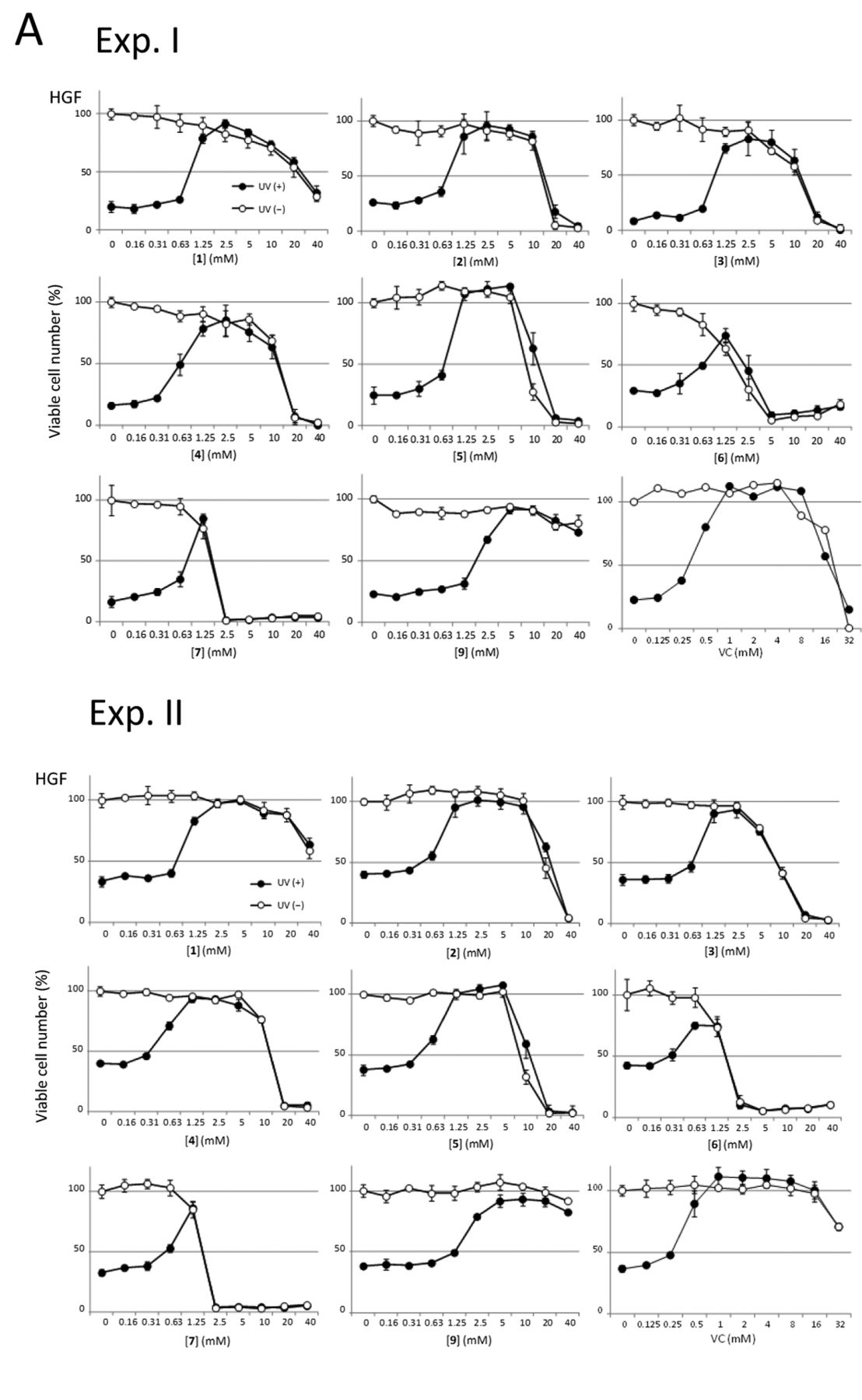
    Figure 4.

    Effect of UV irradiation on the viability of cultured oral cells. HGF (18 PDL) (A) were exposed to UV irradiation (6 J/m2/min) for 4 minutes, and HSC-2 cells (B) were exposed to UV irradiation for only 30 seconds in PBS(–) containing the indicated concentrations of each azulene. After removing the sample, both cells were incubated for 48 hours in fresh azulene-free culture medium. The viable cell numbers were then determined by 3-(4,5-dimethylthiazol-2-yl)-2,5-diphenyltetrazolium bromide (MTT) method, and expressed as a percentage that of control cells not exposed to UV irradiation. Each value represents the mean±S.D. of triplicate assays in two independent experiments (Exp. I and Exp. II).

Tables

  • Figures
  • Table I.
  • Table II.
  • Table III.
PreviousNext
Back to top

In this issue

In Vivo
Vol. 27, Issue 1
January-Ferbruary 2013
  • Table of Contents
  • Table of Contents (PDF)
  • Index by author
  • Back Matter (PDF)
  • Ed Board (PDF)
  • Front Matter (PDF)
Print
Download PDF
Article Alerts
Sign In to Email Alerts with your Email Address
Email Article

Thank you for your interest in spreading the word on In Vivo.

NOTE: We only request your email address so that the person you are recommending the page to knows that you wanted them to see it, and that it is not junk mail. We do not capture any email address.

Enter multiple addresses on separate lines or separate them with commas.
Anti-UV Activity of Newly-synthesized Water-soluble Azulenes
(Your Name) has sent you a message from In Vivo
(Your Name) thought you would like to see the In Vivo web site.
CAPTCHA
This question is for testing whether or not you are a human visitor and to prevent automated spam submissions.
6 + 0 =
Solve this simple math problem and enter the result. E.g. for 1+3, enter 4.
Citation Tools
Anti-UV Activity of Newly-synthesized Water-soluble Azulenes
JUN-ICHI UEKI, HIROSHI SAKAGAMI, HIDETSUGU WAKABAYASHI
In Vivo Jan 2013, 27 (1) 119-126;

Citation Manager Formats

  • BibTeX
  • Bookends
  • EasyBib
  • EndNote (tagged)
  • EndNote 8 (xml)
  • Medlars
  • Mendeley
  • Papers
  • RefWorks Tagged
  • Ref Manager
  • RIS
  • Zotero
Reprints and Permissions
Share
Anti-UV Activity of Newly-synthesized Water-soluble Azulenes
JUN-ICHI UEKI, HIROSHI SAKAGAMI, HIDETSUGU WAKABAYASHI
In Vivo Jan 2013, 27 (1) 119-126;
Twitter logo Facebook logo Mendeley logo
  • Tweet Widget
  • Facebook Like
  • Google Plus One

Jump to section

  • Article
    • Abstract
    • Materials and Methods
    • Results
    • Discussion
    • Acknowledgements
    • References
  • Figures & Data
  • Info & Metrics
  • PDF

Related Articles

Cited By...

  • Prominent Anti-UV Activity and Possible Cosmetic Potential of Lignin-carbohydrate Complex
  • Anti-UV Activity of Kampo Medicines and Constituent Plant Extracts: Re-evaluation with Skin Keratinocyte System
  • Quantitative Structure-Activity Relationship Analysis of Cytotoxicity and Anti-UV Activity of 2-Aminotropones
  • Cytotoxic Activity of Benzo[b]cyclohept[e][1,4]oxazines
  • Google Scholar

More in this TOC Section

  • Antagonistic Effect of Erythropoietin Receptor Signaling in Macrophages and Type II Alveolar Epithelial Cells on Pulmonary Fibrosis in Mice
  • Association of TIMP2 Gene Variants With Development of Diabetic Retinopathy
  • PLLA and PDLLA Fillers: Linking Crystallinity and Mechanical Stability to Aggregation, Redispersion, and Collagen Formation
Show more Experimental Studies

Keywords

  • Synthesis
  • water-soluble azulenes
  • hormesis
  • cytotoxicity
  • UV protection
  • HGF
  • HPL
  • HPLF cells
In Vivo

© 2026 In Vivo

Powered by HighWire