Main menu

  • Home
  • Current Issue
  • Archive
  • Info for
    • Authors
    • Editorial Policies
    • Advertisers
    • Editorial Board
    • Special Issues
  • Journal Metrics
  • Other Publications
    • Anticancer Research
    • Cancer Genomics & Proteomics
    • Cancer Diagnosis & Prognosis
  • More
    • IIAR
    • Conferences
  • About Us
    • General Policy
    • Contact
  • Other Publications
    • In Vivo
    • Anticancer Research
    • Cancer Genomics & Proteomics

User menu

  • Register
  • Subscribe
  • My alerts
  • Log in
  • My Cart

Search

  • Advanced search
In Vivo
  • Other Publications
    • In Vivo
    • Anticancer Research
    • Cancer Genomics & Proteomics
  • Register
  • Subscribe
  • My alerts
  • Log in
  • My Cart
In Vivo

Advanced Search

  • Home
  • Current Issue
  • Archive
  • Info for
    • Authors
    • Editorial Policies
    • Advertisers
    • Editorial Board
    • Special Issues
  • Journal Metrics
  • Other Publications
    • Anticancer Research
    • Cancer Genomics & Proteomics
    • Cancer Diagnosis & Prognosis
  • More
    • IIAR
    • Conferences
  • About Us
    • General Policy
    • Contact
  • Visit iiar on Facebook
  • Follow us on Linkedin
Research ArticleClinical Studies

Familial Hodgkin's Lymphoma in Scandinavia

VIGGO JØNSSON, HANEEF AWAN, EMIL NYQUIST, MARTIN MAISENHØLDER, TOM B. JOHANNESEN, BERNT LY and GEIR E. TJØNNFJORD
In Vivo May 2011, 25 (3) 431-437;
VIGGO JØNSSON
  • Find this author on Google Scholar
  • Find this author on PubMed
  • Search for this author on this site
  • For correspondence: viggo.jonsson{at}medisin.uio.no
HANEEF AWAN
  • Find this author on Google Scholar
  • Find this author on PubMed
  • Search for this author on this site
EMIL NYQUIST
  • Find this author on Google Scholar
  • Find this author on PubMed
  • Search for this author on this site
MARTIN MAISENHØLDER
  • Find this author on Google Scholar
  • Find this author on PubMed
  • Search for this author on this site
TOM B. JOHANNESEN
  • Find this author on Google Scholar
  • Find this author on PubMed
  • Search for this author on this site
BERNT LY
  • Find this author on Google Scholar
  • Find this author on PubMed
  • Search for this author on this site
GEIR E. TJØNNFJORD
  • Find this author on Google Scholar
  • Find this author on PubMed
  • Search for this author on this site
  • Article
  • Figures & Data
  • Info & Metrics
  • PDF
Loading

Abstract

From 2005 to 2010, eight families with clustering of Hodgkin's lymphoma and other lymphoproliferative disorders were found: Hodgkin's lymphoma 9 cases, chronic lymphocytic leukemia 8, non-Hodgkin's lymphoma 3, and multiple myeloma 1 case. Seven cases of Hodgkin's lymphoma, all males, were seen in pleiotropic pairs of affected family members from two successive generations; two patients were sisters. Five of the seven pairs showed sign of anticipation. The 7 males with Hodgkin's lymphoma were found in 5 patrilineal pairs and 2 matrilineal pairs; 6 parent–offspring pairs and 1 uncle–nephew pair. In contrast to the matrilineal pairs, all patrilineal pairs, apart from one family with an only child, had healthy older siblings in accordance with a birth-order effect. The association among Hodgkin's lymphoma, males, and other lymphoproliferative disorders undoubtedly reflects genotypic traits of the susceptibility. A non-Mendelian segregation is discussed comprising genomic parental imprinting and incomplete penetrance susceptibility in both familial and solitary cases.

  • Hodgkin's lymphoma
  • chronic lymphocytic leukemia
  • genetic segregation
  • pleiotropy
  • genomic imprinting
  • birth-order effect
  • anticipation

Familial clustering of lymphoproliferative disorders (LPD) has been fully confirmed since 1947, when Videbaek described two brothers, one with chronic lymphocytic leukemia (CLL) at the age of 45, and the other with Hodgkin's lymphoma (HL) at the age of 29 (1). LPD comprises malignant monoclonal lymphoproliferative disease of all kinds, such as acute lymphoblastic leukemia (ALL), CLL including chronic lymphocytosis of uncertain significance, non-Hodgkin's lymphoma (NHL) and Hodgkin's lymphoma (HL), multiple myeloma, and progressive monoclonal gammopathy of uncertain significance. Interpretation of bulk-data from cancer registries with systematic crosscheck of first-degree relatives (2-7), and analyses of pedigrees from LPD-affected families in case histories and case–control studies, both from older reports (8, 9) and from recent published cases (10-13), make it relevant now to regard LPD as a genetic entity, in which the same genes encode different manifestations, so-called pleiotropy. Different manifestations in familial coexpression of LPD have indeed been disclosed. In a large survey, the relative risk (RR) for HL among first-degree relatives of LPD patients is 3.7 for men and 1.0 for women, with a remarkably different RR for CLL in first-degree relatives (men 6.9, women 8.6), for NHL (men 1.4, women 1.5) and for multiple myeloma (men 2.8, women 0.5) (2), but without significantly increased risk for NHL among siblings of patients with HL (4). In siblings of patients with HL, the RR for HL is more than five-fold increased (6), while the risk of HL in monozygotic twins is about 100-fold increased and higher than in dizygotic twins (14), which also strongly supports a genetic etiology for HL.

Unlike sporadic cases of HL, familial HL is generally seen in younger patients, but with the same frequency of the histopathological subtypes as seen in non-familial, sporadic cases (10), and with the same response to treatment, including the same rate of cure as in non-familial HL (15). In such families, anticipation confers an increasingly lower age at onset of disease and an increased severity of disease down through the generations. In other words, a sort of genetic enhancement which has been ascribed to amplification of abnormal tri- and poly-nucleotide repeats inside the susceptibility genes (16-18). Anticipation has been seen when comparing the age at onset of LPD in large series of parent–offspring pairs and grand parent–parent–offspring combinations with HL (19-21), while others have failed to find anticipation in familial HL (16). For comparison, anticipation has also been discussed for CLL, where it is hardly present at a statistically significant level when CLL is leading, viz. parental, or the only diagnosis of the pair (22).

View this table:
  • View inline
  • View popup
  • Download powerpoint
Table I.

Concomitant lymphoproliferative disease in familial Hodgkin's lymphoma.

Candidate susceptibility loci have been described for both HL (23, 24) and CLL (25, 26) and most likely, the united LPD susceptibility genome is a polyallelic pool of genes available for meiosis under constant modulation from anticipation and under epigenetic influence, giving rise to a birth-order effect with a male predominance (27). Apparently, the HL genome has a weak association with HLA, both class I, and class II, especially DRB1, DQA1 and DQB1 loci (28-30). Theoretically, this modulating pool of susceptible polygenes has a huge capacity to segregate into a large number of hybrid-mosaics, one or perhaps a few hierarchical repeats specific for each of the different LPD diagnoses with a varying power of penetration. This genotypic pool of susceptibility represents the predisposition to mutation(s) in the growth-and-differentiation genes of the lymphoid stem cell (31). From this initial lesion, an autonomic lymphocytic monoclone may emerge and develop into manifest LPD, depending on e.g. age, gender and autoantigeneic drive, and sometimes on epigenetic environmental hits such as stimulation from lymphotrope virus such as Epstein-Barr virus (EBV), and stimulation from the antigeneic drive of many other types of infections (31-33). In a discussion of different putative genetic and infectious etiologies in HL and NHL, mutations in mismatch repair genes have been pointed out as one likely germline alteration involved in LPD clustering, which also provide an explanation for the early-onset CNS tumors in such families (6). In other studies, germline FAS mutations have been related to the increased rate of HL and NHL in familial autoimmune disease (34). Due to the inflammatory component of HL, it is difficult to ascribe a certain genetic defect either to the real, inborn susceptibility-related genotype, or, alternatively, to genes coding for the phenotypic inflammatory and reactive manifestations during tumorigenesis (32, 35, 36).

However, from a genealogical point of view, the segregation of the LPD-susceptibility genes is largely unknown, clearly non-Mendelian as already stated in 1983 (8), and most likely under epigenetic influence (8, 22, 27). The purpose of the present paper is to discuss the segregation of HL from a genealogical point of view and to outline some main characteristics.

Patients and Methods

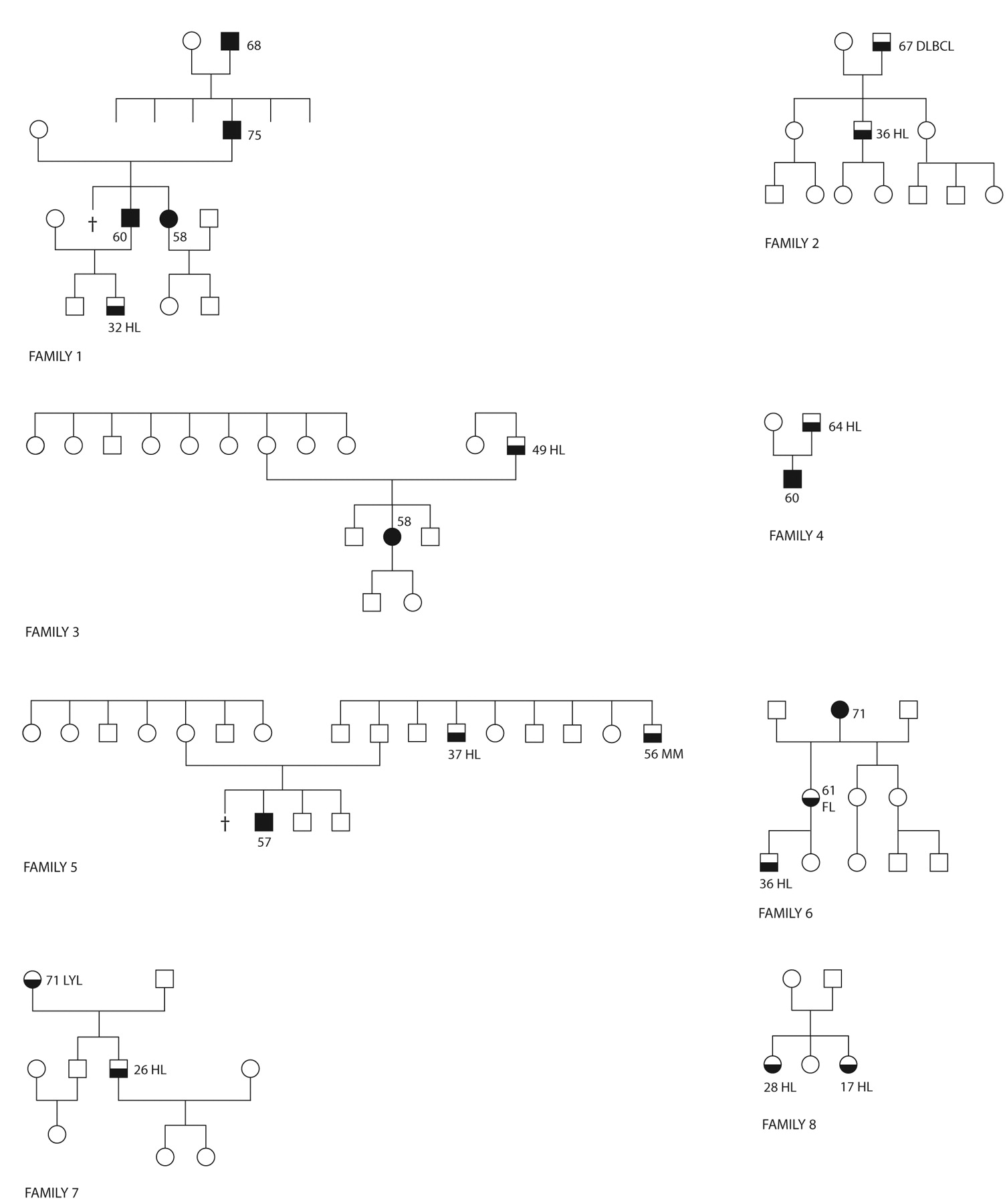
Families with Hodgkin's lymphoma. Our database on familial LPD has eight families with HL from January 2005 to June 2010. Five families (Figure 1, no. 3, 4, 5, 7 and 8) are of Norwegian origin, two families (no. 1 and 2) are Danish ,where the father with DLBCL in family no. 2 is living in Norway, and one family (no. 6) is Swedish, with the proband living in Norway. Seven families have affected family members in two or more generations (Figure 1, Table I) and one family presents a sibling concordance: Two sisters, born 1977 and 1988, both diagnosed with HL the same day in January 2005. The eight HL families have been extracted from a total of 65 families with two or more cases of LPD from the same period.

To ensure maximal ascertainment of familial cases, each LPD patient underwent an interview about other family members with HL or any other malignant hematological disease and the family tree was drawn. Each patient was asked about the number and position of healthy family members, stillborns and extra marital individuals. All patients were allowed sufficient time for discussion with other family members. Both patients and healthy family members were informed about the purpose of the study and that data were confidential and unrecognisable outside of the study. The study was approved by the Regional Committees for Medical Research Ethics in Norway.

Figure 1.
  • Download figure
  • Open in new tab
  • Download powerpoint
Figure 1.

Eight families with Hodgkin's lymphoma and other lymphoproliferative disease. Signature: The figures within the pedigrees indicate the age at onset of disease. Black, CLL; white, healthy; white to black from top to bottom indicates lymphoproliferative disorder other than Hodgkin's lymphoma. CLL, Chronic lymphocytic leukemia; DLBCL, diffuse large B-cell lymphma; FL, follicular lymphoma; HL, Hodgkin's lymphoma; LYL, lymphoplasmocytic lymphoma; MM, multiple myeloma; †death as a child.

Information provided by patients was cross checked with the Cancer Registry in Norway and with the hospital records. Histopathological and laboratory reports, including information from flow cytometry and cytogenetics, were reviewed when available. The healthy family members were cross checked and confirmed by the Civil Person Registry of Norway to ensure the right position of each person in the pedigree, including possible extra-marital children.

About 25 persons were examined per family together with the proband's parents, siblings and children, mainly maternal and paternal uncles and aunts, cousins and their children etc., giving a total of about 200 persons screened within the eight HL-families.

Concomitant LPD. The LPD diagnoses of the eight families (Figure 1, Table I) are based on standard criteria (37). There were 12 cases of LPD other than HL: 8 of CLL, 3 of nonHodgkin's lymphoma, and 1 of multiple myeloma.

Results

A total of 9 cases of familial LPD with HL were found in 8 families (Figure 1, Table I), corresponding to 8 (12%) HL-affected families from a cohort of 65 families with clustering of LPD. There were 7 male and 2 female HL patients in the 65 families, which is significantly more than expected when comparing with the occurrence of HL in the general population. Calculations based on the age-adjusted incidences (2.8 male HL patients per 100,000 persons per year and 1.4 female HL patients per 100,000 persons per year in Norway, 2008 (38) produce an expected number of HL in the 65 families with 1,625 persons (25 cross-checked persons per family) which is significantly lower (p<0.0001) with any relevant statistical model applied: 45.5×10⁻³ male HL patients and 22.8×10⁻³ female HL patients per year, compared with the 1.6 males and 0.4 females per year (7 males and 2 females during 4.5 years) seen in the families.

Seven HL cases, all males, were seen in pleiotropic pairs of affected family members from two successive generations, and two HL cases were sisters. The 7 males with HL were found in 5 patrilineal pairs and 2 matrilineal pairs, 6 parent–offspring pairs and 1 uncle–nephew pair. The male predominance in familial HL observed in the present investigation is in accordance with the male predominance seen in the age-adjusted incidences of HL. The male predominance is further reinforced by the predominant patrilinieal occurrence of HL in the transmission of LPD: 5 patrilineal pairs (Figure 1, no. 1, 2, 3, 4, 5) in contrast to only 2 matrilineal pairs (Figure 1, no. 6 and 7).

The 9 HL patients were seen among 12 family members with LPD other than HL where CLL was predominant (8 cases of CLL) and CLL was one of the two diagnoses in 4 (Figure 1, no. 1, 3, 4 and 5) out of 7 pairs with HL. In spite of the small numbers and only 8 families investigated, 8 cases of CLL (5 males and 3 females) among the 200 persons screened from the 8 families is a very high occurrence when compared with the age-adjusted incidence of CLL in Norway [7.3 male CLL patients per 100,000 persons per year and 3.2 female CLL patients per 100,000 persons per year (38)] linking familial CLL and HL closely. Based on data from these incidences, the expected numbers of CLL patients among 200 persons per year is significantly lower (14.6×10⁻³ males and 6.4×10⁻³ females, p<0.001).

Discussion

Other reported families with HL have shown a predominant patrilineal transmission, e.g. two affected boys and an affected father (11), and three affected boys with the same unaffected father but different mothers (13). A similar stronger familial association among men than among women is also seen in NHL (2, 4, 39) and in CLL (27), but not in familial monoclonal gammopathy of uncertain significance and myeloma (40). This association among HL, men, and LPD in both HL-LPD and LPD-HL pairs is in favor of a shared genotypic susceptibility. Since no data yet relate LPD susceptibility to the Y chromosome, a non-Mendelian segregation with genomic, parental imprinting seems likely (8, 41-43).

Genomic imprinting is a parental-specific gene expression based on intrauterine regulation of the fetal genetic material, giving rise to monoallelic genes depending on the paternal or maternal origin of the allele. Imprinted genes are monoallelically expressed and regulated independently of spermiogenesis and oogenesis by allele-specific epigenetic modifiers (silencer), where DNA methylation and modifications of histones are well described mechanisms (44-46). Genomic imprinting enables the female to transfer selected alleles to her offspring in a birth order. Such a birth-order effect has recently been discussed in relation to CLL and LPD, where patrilineal CLL is mainly given to the youngest in the sibship while matrilineal CLL is randomly distributed in the sibship (27). A birth order is also seen in the present material in an excess of males where the HL-affected offspring in all patrilineal combinations, except for the family with an only child, have a healthy older sibling. This mechanism supposedly secures the transmission of susceptibility genes to the offspring under the condition that paternal genes are suppressed and restricted to males and to the youngest children, supported by anticipation, which also tends to make the susceptibility genes available for the youngest. In both the matrilineal pairs, and in 3 out of 5 patrilineal pairs of the present material (Table I), anticipation is clearly seen with regard to the lowest age at onset of disease in the offspring, while anticipation with regard to increased aggressiveness of disease down through the generations is hardly visible since no high-grade malignant LPD diagnosis, for example ALL, were found.

‘Outbreak’ of HL among siblings has been related to EBV infection (7, 12, 47-50). The two sisters with HL reported in family no. 8 (Figure 1) are EBV negative, viz. in situ hybridization for EBV in the lymphoma tissue was negative. To our knowledge, these cases are unusual with regard to the female concordance and the simultaneous onset of disease. Most reported siblings with HL are males (11-13) or brother-sister combinations (10, 12), with or without in situ EBV expression by the tumor cells, two cases being EBV negative, namely the present family no. 8, and a familial case of Indo-Iranian origin (10). We find it hard to believe that EBV or any other type of environmental stimulation can exert its action alone and without an inborn susceptibility and we presume that the etiology of solitary cases of HL and the rare cases of post-transplant HL (51, 52) are also dependent on congenital susceptibility, having a low or incomplete penetrance in unaffected and healthy family members so that seemingly, no other member of the family has LPD (16, 31). Using computed likelihood analysis of the descent structure in HL pedigrees, Thompson estimated as early as 1981 that the genotype in HL has a recessive nature (53). The existence of carriers, e.g. unaffected parents between an LPD-affected grandparent and an LPD-affected child, fits in with the concept of low-penetration susceptibility in healthy family members. Such carriers have been pointed out in pedigrees with familial CLL and NHL (16, 27). In other words, solitary cases of HL and other types of solitary LPD seem to be identical with familial cases, with the exception that the power of penetration of the susceptibility genes in families with solitary cases is generally low. No differences can be seen in the cytogenetic profile of solitary and familial CLL (25), nor has any difference in the outcome of treatment between solitary and familial LPD been recorded (15). This supports the idea that solitary and familial LPD of all kinds are united in the same entity. Regarding HL, no genealogical investigation of cross checked LPD in major consecutive cohorts of HL has been published so far. To rely on such a survey, it must be based on a large LPD cohort and also include low-grade subsets of LPD with no or nearly no symptoms, e.g. chronic lymphocytosis of uncertain significance, monoclonal gammopathy of uncertain significance, stage A CLL and stage IA HL, to ensure that cases of LPD with low penetrance are also detected and included in the calculations.

Acknowledgements

We are grateful to the patients and their families for their participation in this study. Signe Nøsterud and Birgit Skjelvik are thanked for excellent technical assistance. The study was undertaken in accordance with the Declaration of Helsinki. We thank the Norwegian Data Inspectorate (record no. 07/00254-2), the Social and Health Directorate in Oslo (record no. 07/324), and the Regional Committees for Medical Research Ethics in Norway (record S 06353b) for permission to carry out the study and for access to data. We are grateful to the Institute of Clinical Medicine, University of Oslo, for financial support.

  • Received November 30, 2010.
  • Revision received January 31, 2011.
  • Accepted February 1, 2011.
  • Copyright © 2011 The Author(s). Published by the International Institute of Anticancer Research.

References

  1. ↵
    1. Videbaek AA
    : Heredity in Human Leukemia and Its Relation to Cancer. Copenhagen, Nyt Nordisk Arnold Busck Publ., pedigree 68, p. 167, 1947.
  2. ↵
    1. Goldin LR,
    2. Pfeiffer RM,
    3. Gridley G,
    4. Gail MH,
    5. Li X,
    6. Mellemkjaer L,
    7. Olsen JH,
    8. Hemminki K,
    9. Linet MS
    : Familial aggregation of Hodgkin lymphoma and related tumors. Cancer 100: 1902-1908, 2004.
    OpenUrlCrossRefPubMed
    1. Altieri A,
    2. Hemminiki K
    : The familial risk of Hodgkin's lymphoma ranks among the highest in Swedish Family Cancer Database. Leukemia 20: 2062-2063, 2006.
    OpenUrlCrossRefPubMed
  3. ↵
    1. Wang SS,
    2. Slager SL,
    3. Brennan P,
    4. Holly EA,
    5. De Sqanjose S,
    6. Bernstein L,
    7. Boffetta P,
    8. Cerhan JR,
    9. Maynadie M,
    10. Spinelli JJ,
    11. Chiu BCH,
    12. Cocco PL,
    13. Mensah F,
    14. Zhang Y,
    15. Nieters A,
    16. Dal Manso L,
    17. Bracci PM,
    18. Constantini AS,
    19. Vineis P,
    20. Stevenson RK,
    21. Roman E,
    22. Cozen W,
    23. Weisenburger D,
    24. Davis S,
    25. Franceschi S,
    26. La Vecchia C,
    27. Foretova L,
    28. Becker N,
    29. Staines A,
    30. Vornanen M,
    31. Zheng T,
    32. Hartge P
    : Family history of hematopoietic malignancies and risk of non-Hodgkin lymphoma (NHL), a pooled analysis of 10,211 cases and 11,905 controls from the International Lymphoma Epidemiology Consortium (InterLymph). Blood 109: 3479-3488, 2007.
    OpenUrlAbstract/FREE Full Text
    1. Paltiel O
    : Family matters in Hodgkin lymphoma. Leuk Lymphoma 49: 1234-1235, 2008.
    OpenUrlPubMed
  4. ↵
    1. Pang D,
    2. Alston RD,
    3. Eden TO,
    4. Birch JM
    : Cancer risks among relatives of children with Hodgkin and non-Hodgkin lymphoma. Int J Cancer 123: 1407-1410, 2008.
    OpenUrlCrossRefPubMed
  5. ↵
    1. Mani H,
    2. Jaffe ES
    : Hodgkin lymphoma, an update on its biology with newer insights into classification. Clin Lymphoma Myeloma 9: 206-216, 2009.
    OpenUrlPubMed
  6. ↵
    1. Kerzin-Storrar L,
    2. Faed MJW,
    3. MacGillivay JB,
    4. Smith PG
    : Incidence of familial Hodgkin's disease. Br J Cancer 47: 707-712, 1983.
    OpenUrlPubMed
  7. ↵
    1. Ferraris AM,
    2. Racchi O,
    3. Rapezzi D,
    4. Gaetani GF,
    5. Boffetta P
    : Familial Hodgkin's disease, a disease of younger adulthood? Ann Hematol 74: 131-134, 1997.
    OpenUrlCrossRefPubMed
  8. ↵
    1. Campell GNS,
    2. Lloyd J,
    3. Wotherspoon A,
    4. Coulter C,
    5. Bain BJ
    . Nodular lymphocyte predominant Hodgkin lymphoma in siblings. Leuk Lymphoma 45: 609-611, 2004.
    OpenUrlPubMed
  9. ↵
    1. Bauduer F,
    2. Vassallo J,
    3. Delsol G,
    4. Brousset P
    : Clustering and anticipation for nodular lymphocyte predominance Hodgkin lymphoma within a French Basque kindred. Br J Haematol 130: 647-649, 2005.
    OpenUrlCrossRefPubMed
  10. ↵
    1. Kamper PM,
    2. Kjeldsen E,
    3. Clausen N,
    4. Bendix K,
    5. Hamilton-Dutoit S,
    6. d'Amore F
    : Epstein-Barr virus associated familial Hodgkin lymphoma, paediatric onset in three of five siblings. Br J Haematol 129: 615-617, 2005.
    OpenUrlPubMed
  11. ↵
    1. Rehman JU,
    2. Burney IA,
    3. Kindi SA,
    4. Raeburn S
    : Familial lymphoma in an Omani kindred with identical class II HLA type. Leuk Lymphoma 49: 1407-1410, 2008.
    OpenUrlPubMed
  12. ↵
    1. Mack TM,
    2. Cozen W,
    3. Shibata DK,
    4. Weiss LM,
    5. Nathwani BN,
    6. Hernandez AM,
    7. Taylor CR,
    8. Hamilton AS,
    9. Deapen DM,
    10. Rappaport EB
    : Concordance for Hodgkin's disease in identical twins suggesting genetic susceptibility to the young-adult form of the disease. N Engl J Med 332: 413-418, 1995.
    OpenUrlCrossRefPubMed
  13. ↵
    1. Anderson LA,
    2. Pfeiffer RM,
    3. Rapkin JS,
    4. Gridly G,
    5. Mellemkjaer L,
    6. Hemminki K,
    7. Björkholm M,
    8. Caporaso NE,
    9. Landgren O
    : Survival patterns among lymphoma patients with a family history of lymphoma. J Clin Oncol 26: 4958-4965, 2008.
    OpenUrlAbstract/FREE Full Text
  14. ↵
    1. Horwitz M,
    2. Goode EL,
    3. Jarvik GP
    : Anticipation in familial leukemia. Am J Hum Genet 59: 990-998, 1996.
    OpenUrlPubMed
    1. Pearson CE,
    2. Nichol Edamura K,
    3. Cleary JD
    : Repeat instability, mechanisms of dynamic mutations. Nat Rev Genet 6: 729-742, 2005.
    OpenUrlCrossRefPubMed
  15. ↵
    1. Auer RL,
    2. Dighiero G,
    3. Goldin LR,
    4. Syndercombe-Court D,
    5. Jones C,
    6. McElwaine S,
    7. Newland AC,
    8. Fegan CD,
    9. Caporaso N,
    10. Cotter FE
    : Trinucleotide repeat dynamic mutation identifying susceptibility in familial and sporadic chronic lymphocytic leukaemia. Br J Haematol 136: 73-79, 2006.
    OpenUrlPubMed
  16. ↵
    1. Shugart YY
    : Anticipation in familial Hodgkin lymphoma. Am J Hum Genet 63: 270-272, 1998.
    OpenUrlPubMed
    1. Lynch HT
    : Anticipation in familial Hodgkin's lymphoma. Hum Genet 107: 290-293, 2000.
    OpenUrlPubMed
  17. ↵
    1. Shugart YY,
    2. Hemminki K,
    3. Vattinen P,
    4. Kingman A,
    5. Dong C
    : A genetic study of Hodgkin's lymphoma, an estimation of heritability and anticipation based on the familial cancer database in Sweden. Hum Gen 106: 553-556, 2000.
    OpenUrlCrossRefPubMed
  18. ↵
    1. Awan H,
    2. Jønsson V,
    3. Johannesen TH,
    4. Ly B,
    5. Tjønnfjord GE
    : Anticipation in families with chronic lymphocytic leukemia and other lymphoproliferative disorders. Translat Oncogenomics 5: 1-9, 2010.
    OpenUrl
  19. ↵
    1. Goldin LR,
    2. McMaster ML,
    3. Ter-Minasssian M,
    4. Saddlemire S,
    5. Harmsen B,
    6. Lalonde G,
    7. Tucker MA
    : A genome screen of families at high risk for Hodgkin lymphoma: evidence for a susceptibility gene on chromosome 4. J Med Genet 42: 595-601, 2005.
    OpenUrlFREE Full Text
  20. ↵
    1. Liang XS,
    2. Caporaso N,
    3. McMaster ML,
    4. Ng D,
    5. Landgren O,
    6. Yeager M,
    7. Chanock S,
    8. Goldin LR
    : Common genetic variants in candidate genes and risk of familial lymphoid malignancies. Br J Haematol 146: 418-423, 2009.
    OpenUrlCrossRefPubMed
  21. ↵
    1. Sellick GS,
    2. Webb EL,
    3. Allinson R,
    4. Matutes E,
    5. Dyer MJS,
    6. Jønsson V,
    7. Langerak AW,
    8. Mauro FR,
    9. Fuller S,
    10. Wiley J,
    11. Lyttelton M,
    12. Callea V,
    13. Yuille M,
    14. Catovsky D,
    15. Houlston R
    : A high-density SNP genome-wide linkage scan for chronic lymphocytic leukemia-susceptibility loci. Am J Hum Genet 77: 420-429, 2005.
    OpenUrlCrossRefPubMed
  22. ↵
    1. Di Bernardo MC,
    2. Chrowther-Swanepoel D,
    3. Broderick P,
    4. Webb E,
    5. Sellick G,
    6. Wild R,
    7. Sullivan K,
    8. Vijayakrishnan J,
    9. Wang Y,
    10. Pittman AM,
    11. Sunter NJ,
    12. Hall AG,
    13. Dyer MJS,
    14. Matutes E,
    15. Dearden C,
    16. Mainou-Fowler T,
    17. Jackson GH,
    18. Summerfield G,
    19. Harris RJ,
    20. Pettitt AR,
    21. Hillmen P,
    22. Allsup DJ,
    23. Bailey JR,
    24. Pratt G,
    25. Pepper C,
    26. Fegan C,
    27. Allan JM,
    28. Catovsky D,
    29. Houlston RS
    : A genome-wide association study identifies six susceptibility loci for chronic lymphocytic leukemia. Nature Genet 40: 1204-1210, 2008.
    OpenUrlCrossRefPubMed
  23. ↵
    1. Jønsson V,
    2. Tjønnfjord GE,
    3. Johannesen TB,
    4. Ly B,
    5. Olsen JH,
    6. Yuille M
    : Familial chronic lymphocytic leukemia in Norway and Denmark, comments on pleiotropy and birth order. In Vivo 24: 84-96, 2010.
    OpenUrl
  24. ↵
    1. Hors J,
    2. Dausset J
    : HLA and susceptibility to Hodgkin's disease. Immunol Rev 70: 167-192, 1983.
    OpenUrlCrossRefPubMed
    1. Harty LC,
    2. Lin AY,
    3. Goldstein AM,
    4. Jaffe ES,
    5. Carrington M,
    6. Tucker MA,
    7. Modi WS
    : HLA-DR, HLA-DQ and TAP genes in familial Hodgkin's disease. Blood 99: 690-693, 2002.
    OpenUrlAbstract/FREE Full Text
  25. ↵
    1. Gruffeman S,
    2. Delzell E
    : Epidemiology of Hodgkin's disease. Epidem Rev 6: 76-106, 1984.
    OpenUrl
  26. ↵
    1. Skibola CF,
    2. Curry JD,
    3. Nieters A
    : Genetic susceptibility to lymphoma. Hematologica 92: 960-969, 2007.
    OpenUrlAbstract/FREE Full Text
  27. ↵
    1. Meyer RM,
    2. Ambinder RF,
    3. Stroobants S
    : Hodgkin's lymphoma, evolving concepts with implication for practice. Hematology, Suppl. Am Soc Hematol Educ Program, pp. 1326-1329, 2004.
  28. ↵
    1. Janz M,
    2. Mathas S
    : The pathogensis of classical Hodgkin's lymphoma, what can we learn from analyses of genomic alteration in Hodgkin and Reed-Sternberg cells? Hematologica 93: 1292-1295, 2008.
    OpenUrlFREE Full Text
  29. ↵
    1. Straus SE,
    2. Jaffe ES,
    3. Puck JM,
    4. Dale JK,
    5. Elkon KB,
    6. Rösen-Wolff A,
    7. Peters AM,
    8. Sneller MC,
    9. Hallaham CM,
    10. Wang J,
    11. Fischer RE,
    12. Jackson CM,
    13. Lin AY,
    14. Bäumler C,
    15. Siegert E,
    16. Marx A,
    17. Vaishnaw AK,
    18. Grodzicky T,
    19. Fleisher TA,
    20. Lenardo MJ
    : The development of lymphomas in families with autoimmune lymphoproliferative syndrome with germline FAS mutations and defective lymphocyte apoptosis. Blood 98: 194-200, 2001.
    OpenUrlAbstract/FREE Full Text
  30. ↵
    1. Schmitz R,
    2. Stanelle J,
    3. Hansmann ML,
    4. Küppers R
    : Pathogenesis of classical and lymphocyte-predomionant Hodgkin's lymphoma. Annu Rev Pathol 4: 151-174, 2009.
    OpenUrlCrossRefPubMed
  31. ↵
    1. El-Zein R,
    2. Monroy CM,
    3. Etzel CJ,
    4. Cortes AC,
    5. Xing Y,
    6. Collier AL,
    7. Strom SS
    : Genetic polymorphisms in DNA repair genes as modulators of Hodgkin's disease risk. Cancer 115: 1651-1659, 2009.
    OpenUrlPubMed
  32. ↵
    1. Jaffe E,
    2. Harris NL,
    3. Stein H,
    4. Vardiman J
    : WHO Classification of Tumours, Pathology and Genetics of Tumours of the Haematopoietic and Lymphoid Tissues. Lyon: IARC Press, 2001.
  33. ↵
    Report from the Norwegian Cancer Registry, www.kreftregisteret.no/Registries/CancerStatistics
  34. ↵
    1. Chatterjee N,
    2. Hartge P,
    3. Cerhan JR,
    4. Cozen W,
    5. Davis S,
    6. Ishibe N,
    7. Colt J,
    8. Goldin L,
    9. Severson RK
    : Risk of non-Hodgkin's lymphoma and family history of lymphatic, hematological, and other cancers. Cancer Epidemiol Biomarkers Prev 13: 1415-1421, 2004.
    OpenUrlAbstract/FREE Full Text
  35. ↵
    1. Jain M,
    2. Ascensao J,
    3. Schlechter GP
    : Familial myeloma and monoclonal gammopathy, a report of eight African–American families. Am J Hematol 84: 34-38, 2009.
    OpenUrlPubMed
  36. ↵
    1. Haig D
    : The kinship theory of genomic imprinting. Ann Rev Ecol Syst 31: 932, 2000.
    OpenUrl
    1. Edwards CA,
    2. Ferguson-Smith AC
    : Mechanisms regulating imprinted genes in clusters. Curr Opin Cell Biol 19: 281-289, 2007.
    OpenUrlCrossRefPubMed
  37. ↵
    1. Jønsson V,
    2. Tjønnfjord G,
    3. Samuelsen SO,
    4. Johannesen T,
    5. Olsen J,
    6. Sellick G,
    7. Houlston R,
    8. Yuille M,
    9. Catovsky D
    : Birth-order pattern in the inheritance of chronic lymphocytic leukaemia and related lymphoproliferative disease. Leuk Lymphoma 48: 2387-2396, 2007.
    OpenUrlPubMed
  38. ↵
    1. Rush LJ,
    2. Raval A,
    3. Funchain P,
    4. Johnsen AJ,
    5. Smith L,
    6. Lucas DM,
    7. Bembea M,
    8. Liu TH,
    9. Heerema NA,
    10. Rassenti L,
    11. Liyanarachchi S,
    12. Davuluri R,
    13. Byrd JC,
    14. Plass C
    : Epigenetic profiling in chronic lymphocytic leukaemia reveals novel methylation tagets. Cancer Res 64: 2424-2433, 2004.
    OpenUrlAbstract/FREE Full Text
    1. Ubeda F,
    2. Haig D
    : On the evolutionary stability of Mendelian segregation. Genetics 170: 1345-1357, 2005.
    OpenUrlCrossRefPubMed
  39. ↵
    1. Reik W
    : Stability and flexibility of epigenetic gene regulation in mammalian development. Nature 447: 425-432, 2007.
    OpenUrlCrossRefPubMed
  40. ↵
    1. Chang ET,
    2. Zheng T,
    3. Wier EG,
    4. Borowitze M,
    5. Mann RB,
    6. Spiegelman D,
    7. Mueller NE
    : Childhood social environment and Hodgkin's lymphoma. Cancer Epidemiol Biomarkers Prev 13: 1361-1370, 2004.
    OpenUrlAbstract/FREE Full Text
    1. Chatenoud L,
    2. Gallus S,
    3. Altieri A,
    4. Negri E,
    5. Talamini R,
    6. Franceschi S,
    7. La Vecchia C
    : Number of siblings and risk of Hodgkin's lymphoma and other lymphoid neoplasms. Cancer Epidemiol Biomarkers Prev 14: 552, 2005.
    OpenUrlFREE Full Text
    1. Andersson J
    : Epstein-Barr virus and Hodgkin's lymphoma. Herpes 13: 12-16, 2006.
    OpenUrlPubMed
  41. ↵
    1. Hjalgrim H,
    2. Smedby KE,
    3. Rostgaard K,
    4. Molin D,
    5. Hamilton-Dutoit S,
    6. Chang ET,
    7. Ralfkieaer E,
    8. Sundström C,
    9. Adami HO,
    10. Glimelius B,
    11. Melbye M
    : Infectious mononucleosis, childhood, social environment, and risk of Hodgkin's lymphoma. Cancer Res 67: 2382-2388, 2007.
    OpenUrlAbstract/FREE Full Text
  42. ↵
    1. Rohr JC,
    2. Wagner HJ,
    3. Lauten M,
    4. Wacker HH,
    5. Jüttner E,
    6. Hanke C,
    7. Pohl M,
    8. Niemeyer CM
    : Differentiation of EBV-induced post-transplant Hodgkin lymphoma from Hodgkin-like post-transplant lymphoproliferative disease. Pediatr Transplantation 12: 426-431, 2008.
    OpenUrl
  43. ↵
    1. Adams H,
    2. Campidelli C,
    3. Dirnhofer S,
    4. Pileri SA,
    5. Tzankow A
    : Clinical, phenotypic and genetic similarities and disparties between post-transplant and classical Hodgkin lymphomas with respect to therapeutic targets. Expert Opin Ther Targets 13: 1137-1145, 2009.
    OpenUrlPubMed
  44. ↵
    1. Thompson EA
    : Pedigree analysis of Hodgkin's disease in a Newfoundland genealogy. Ann Hum Genet 45: 279-292, 1981.
    OpenUrlPubMed
PreviousNext
Back to top

In this issue

In Vivo
Vol. 25, Issue 3
May-June 2011
  • Table of Contents
  • Table of Contents (PDF)
  • Index by author
  • Back Matter (PDF)
  • Ed Board (PDF)
  • Front Matter (PDF)
Print
Download PDF
Article Alerts
Sign In to Email Alerts with your Email Address
Email Article

Thank you for your interest in spreading the word on In Vivo.

NOTE: We only request your email address so that the person you are recommending the page to knows that you wanted them to see it, and that it is not junk mail. We do not capture any email address.

Enter multiple addresses on separate lines or separate them with commas.
Familial Hodgkin's Lymphoma in Scandinavia
(Your Name) has sent you a message from In Vivo
(Your Name) thought you would like to see the In Vivo web site.
CAPTCHA
This question is for testing whether or not you are a human visitor and to prevent automated spam submissions.
1 + 16 =
Solve this simple math problem and enter the result. E.g. for 1+3, enter 4.
Citation Tools
Familial Hodgkin's Lymphoma in Scandinavia
VIGGO JØNSSON, HANEEF AWAN, EMIL NYQUIST, MARTIN MAISENHØLDER, TOM B. JOHANNESEN, BERNT LY, GEIR E. TJØNNFJORD
In Vivo May 2011, 25 (3) 431-437;

Citation Manager Formats

  • BibTeX
  • Bookends
  • EasyBib
  • EndNote (tagged)
  • EndNote 8 (xml)
  • Medlars
  • Mendeley
  • Papers
  • RefWorks Tagged
  • Ref Manager
  • RIS
  • Zotero
Reprints and Permissions
Share
Familial Hodgkin's Lymphoma in Scandinavia
VIGGO JØNSSON, HANEEF AWAN, EMIL NYQUIST, MARTIN MAISENHØLDER, TOM B. JOHANNESEN, BERNT LY, GEIR E. TJØNNFJORD
In Vivo May 2011, 25 (3) 431-437;
Twitter logo Facebook logo Mendeley logo
  • Tweet Widget
  • Facebook Like
  • Google Plus One

Jump to section

  • Article
    • Abstract
    • Patients and Methods
    • Results
    • Discussion
    • Acknowledgements
    • References
  • Figures & Data
  • Info & Metrics
  • PDF

Related Articles

Cited By...

  • No citing articles found.
  • Google Scholar

More in this TOC Section

  • Association Between Dipeptidyl Peptidase-4 Inhibitor Use and Acute Kidney Injury in Patients With Diabetes Mellitus: A Disproportionality Analysis Based on the FAERS
  • Expression Patterns of T-cell immunoreceptor With Ig and ITIM domains (TIGIT) in Classical Hodgkin Lymphoma: A Clinicopathological Study
  • Older Age and Outcomes of Intravesical Bacillus Calmette-Guérin for Non-muscle-invasive Bladder Cancer
Show more Clinical Studies
In Vivo

© 2026 In Vivo

Powered by HighWire